Of every Sub-Zero complaint we field from Los Altos Hills, the slow or failing ice maker is the one most often blamed on the appliance and least often caused by it. The real culprit is usually what runs through it. The water up here is hard, the ice maker has the narrowest passages in the whole machine, and the two meet badly over time.
This guide is about the water, not the part — how local supply and well water leave the mineral scale that clogs an ice maker, the one maintenance habit that prevents most of it, and how to tell whether your problem is the water or the unit before anyone is standing in your kitchen.
Why the water here is the hard part
Much of Los Altos Hills is served by the Purissima Hills Water District and California Water Service, and both deliver water on the moderately hard end of the scale — enough dissolved calcium and magnesium to leave a film on glassware and a crust on a kettle. The homes on the unincorporated parcels along Moody Road, La Cresta and the higher lanes often sit on private wells, which can be harder still and almost never run through a softener on the line that reaches the kitchen.
That hardness is invisible until it concentrates. An ice maker takes in a small measured slug of water every cycle, freezes it, and ejects it — and every cycle leaves a trace of mineral behind on the fill tube, the inlet-valve seat and the mold. Multiply a trace by thousands of cycles a year and you get scale: a chalky narrowing of passages that were never wide to begin with.
What scale actually does to the ice maker
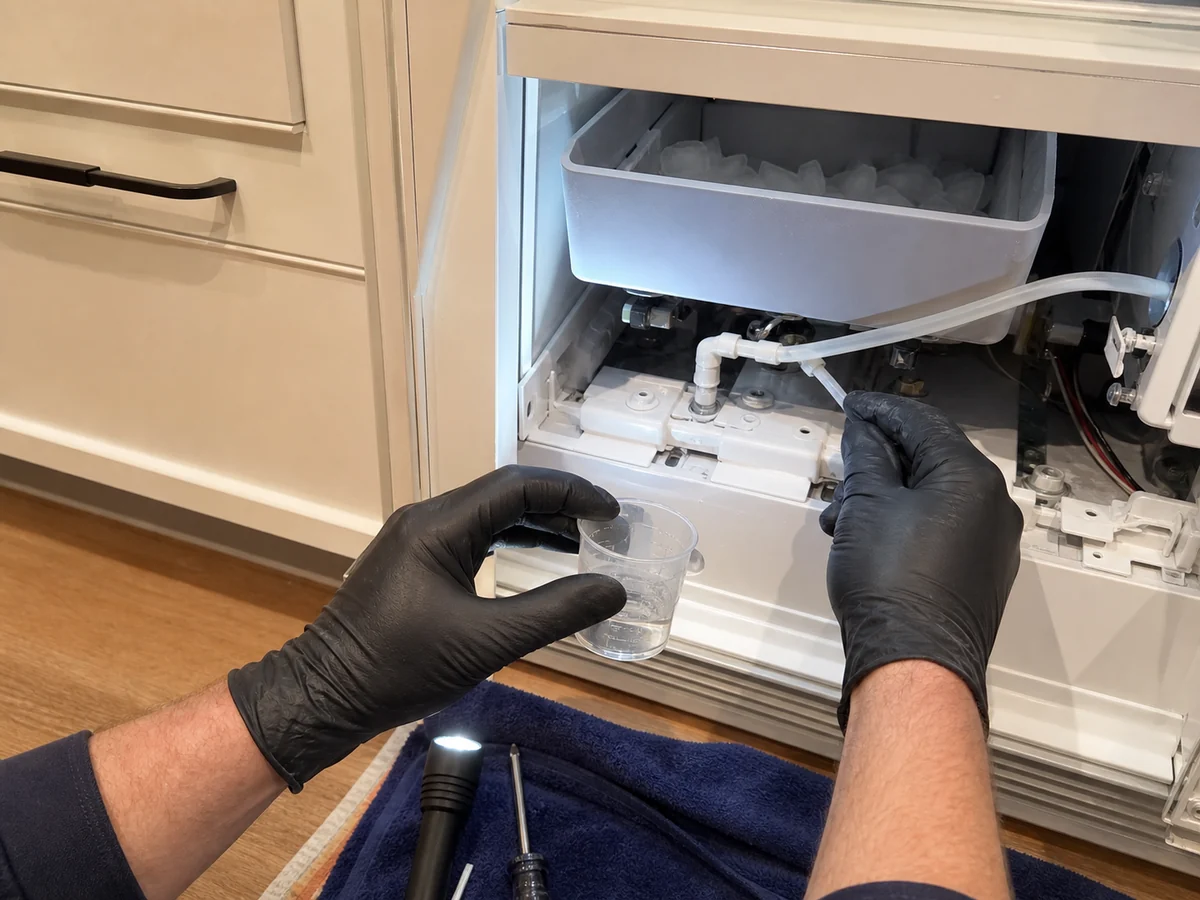
Scale attacks the ice maker in three places. First the fill tube, the thin line that delivers water to the mold: as it narrows, less water arrives per cycle, so cubes come out hollow, thin or half-formed. Then the inlet valve, a small solenoid that opens for a few seconds each fill; mineral on its seat keeps it from closing cleanly, which shows up as a slow weep, an overfill, or — eventually — a valve that won't open at all and an ice maker that simply stops.
The third place is the water filter. A Sub-Zero filter is sacrificial by design, and hard water spends it faster than the calendar suggests. A filter that should last six to twelve months can be effectively done sooner here, and a spent filter restricts flow exactly the way a scaled fill tube does — which is why the first thing to suspect when ice slows is not the module but the filter feeding it. Cloudy cubes and an off taste are the same scale showing up in the finished ice.
The habit that prevents most of it
The cheapest fix is a filter on a real schedule. In a hard-water home up here we suggest changing the genuine filter closer to the six-month end of the range, and noting the date so it isn't guesswork. A fresh filter protects the inlet valve and fill tube downstream of it, so a small recurring cost heads off the larger one.
Beyond the filter, a periodic line flush and a check of the inlet-valve seat keep scale from building where the filter can't reach. We handle both as part of an ice-maker service, and on a unit that has already slowed we measure the actual fill volume per cycle rather than guessing from cube shape — that number tells us whether water is even arriving before we touch a module. The full part-by-part breakdown lives on our ice maker and water line page; this guide is the why behind it.
Is it the water, or the unit?
A few signs point at the water rather than the appliance. If cubes are shrinking gradually rather than stopping suddenly, if they're cloudy or taste flat, if the kettle and the shower glass show the same scale, and if a filter change brings a temporary improvement, the water is doing the damage. A sudden, total stop with clear water elsewhere is more likely a failed module, valve or harness — a unit problem.
When the water is the cause, the fix is maintenance, not a new ice maker: filter, flush, and protect the valve. When the unit has genuinely failed, we match the part to your model and serial. Either way, the mistake to avoid is replacing an expensive module while the same hard water quietly scales the new one — treat the water and the part lasts.