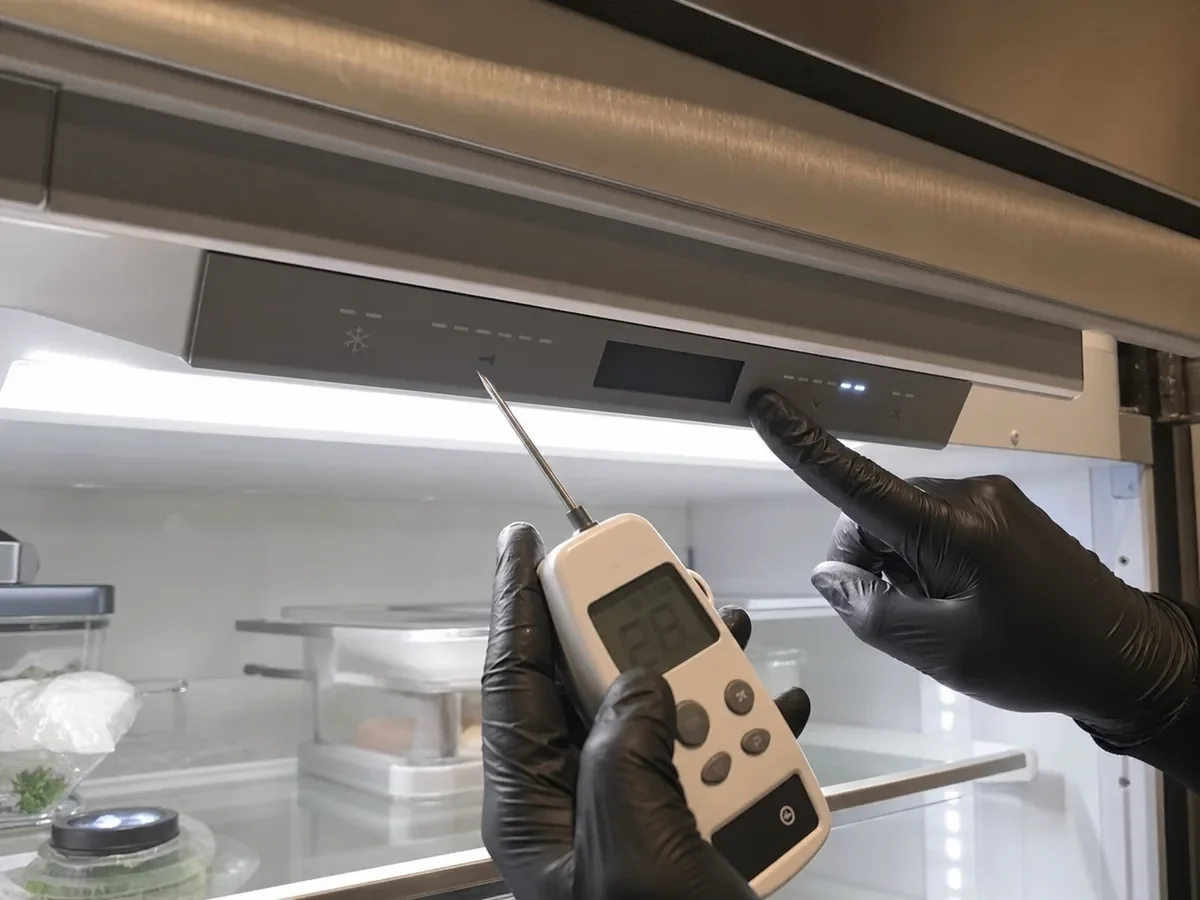
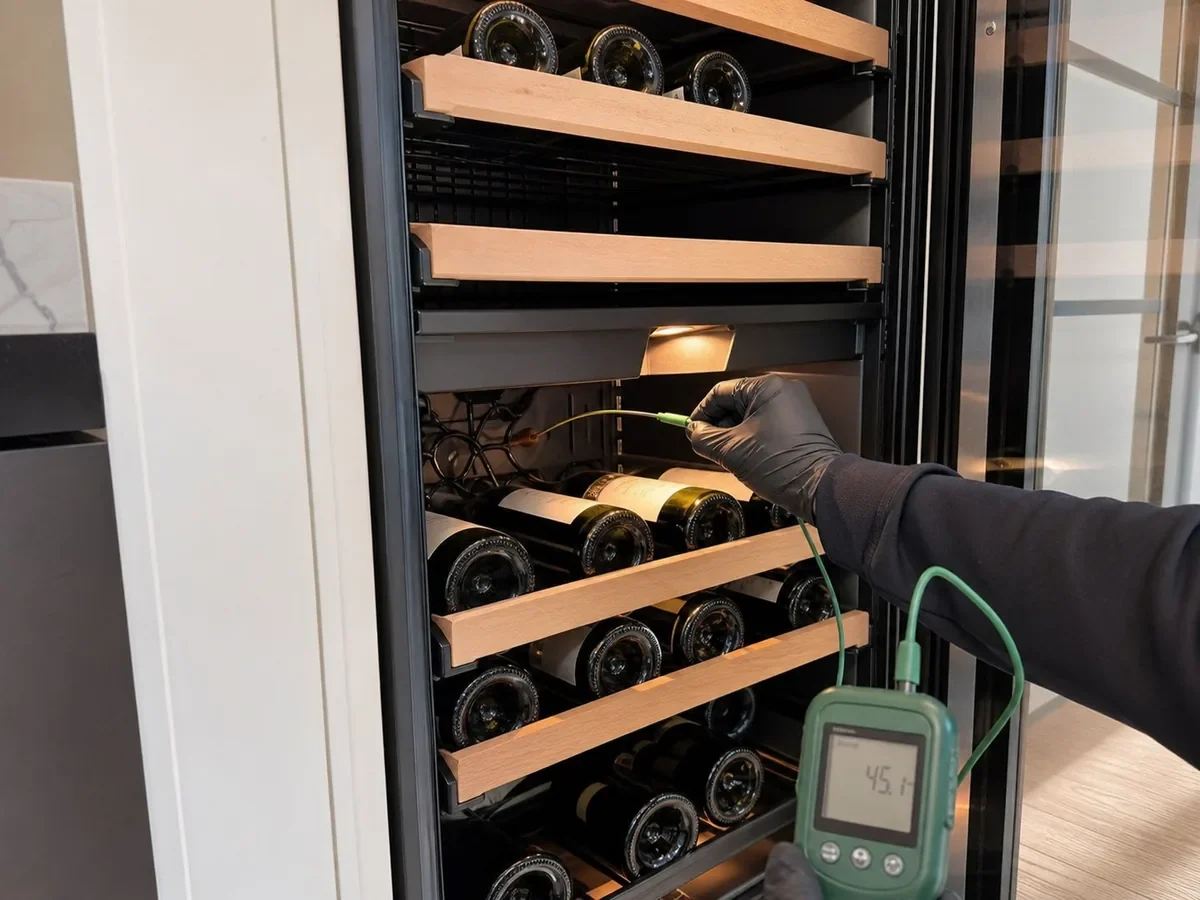
Our 424 column read 59 °F set to 55. They logged set point against a probe over a full cycle, found a drifting thermistor, and recalibrated and replaced the sensor for $340. The bottles were never at risk.
Wine collector, Altamont ridgeClimate care field guide · Wine storage · Los Altos Hills
Your Sub-Zero wine column is drifting a few degrees — is the wine in danger, or is it a sensor?
A Sub-Zero wine column up on Altamont Road that reads 59°F when it's set to 55 is rarely a dying cabinet, and the bottles are almost never lost. The same homes call about an ice maker running slow, jamming, or dropping hollow cubes in the kitchen built-in, and the wine unit drifting is its quiet cousin: a thermistor reading the cabinet wrong, a tired evaporator fan, or a control board that's stopped trusting its own sensor.
We're a Sub-Zero-focused service. On a drift call we log the set point against the actual cabinet temperature over a full cycle before naming a part.
Flat $99 diagnostic, credited toward an approved repair.
Direct answer
When a Sub-Zero wine column drifts several degrees, the cause is usually a thermistor, evaporator fan or control board reading the cabinet wrong — not a failed sealed system and not ruined wine. We log set point against actual over a full cycle, check fan airflow and sensor resistance, and quote in writing. A flat $99 diagnostic is credited toward any approved repair; most wine-unit repairs run $300–$850, with sealed-system work the rare exception at $1,400–$2,900. Exact pricing is confirmed on site after diagnosis.
- Sub-Zero wine-unit repair in Los Altos Hills: zone sensor recalibration $280–$560, zone evaporator fan $360–$740, after the $99 diagnostic.
- A Sub-Zero wine column holds about 55 °F; a 3–6 °F drift is usually a thermistor, fan or control reading the cabinet wrong, not spoiled wine.
- On dual-zone 424/427/430 units, a single drifting zone points to that zone’s sensor or fan, not a whole-unit failure.
Specialized appliance · Why this isn't generic repair · 01
A wine column is a precision climate cabinet, not a small fridge
Sub-Zero engineers a wine unit to hold a narrow band — and that narrow band is exactly why a generalist gets it wrong.
A kitchen refrigerator only has to stay cold enough; a Sub-Zero wine unit has to stay exact. The 424, 427 and 430 columns — and the dual-zone cabinets that hold reds in one bay and whites or sparkling in another — run a tighter control loop, a quieter low-vibration evaporator fan, and often a UV-tinted door whose seal matters as much for temperature as for light. A few degrees of drift that you'd never notice in a fridge is the entire complaint here, because the owner set 55°F on purpose and the cabinet is sitting at 59.
That precision is why a generalist who treats it like a beverage fridge tends to either condemn the whole unit or swap a part on a guess. On a Sub-Zero the drift almost always traces to one of three things reading or moving air wrong — a thermistor, the evaporator fan, or the control board — and which one it is can't be told apart by symptom alone. In Los Altos Hills that matters more than most places: these columns sit in custom millwork, the collections inside them are not casual, and "just replace it" means cabinetry rework on top of the appliance. Diagnosis, not a parts gamble, is what protects both.
Five failures · What's actually drifting · 02
The five things we find behind a drifting Sub-Zero wine column
Ranked roughly simple-to-serious. Each card is the symptom as you'd notice it, what we test to confirm it, the part involved, and the one thing that moves the quote up or down.
1 · Thermistor (temperature sensor) reading wrong
Symptom: the display says one number, your own thermometer in the cabinet says another — often a steady 3–5° gap that never settles. Diagnosis: we measure the thermistor's resistance against the model's spec curve and compare it to a known reference; an out-of-range or noisy reading confirms it. Part: an OEM sensor matched to your serial. What changes the quote: a single fresh-food/upper-zone sensor is the low end; a dual-zone unit with a second sensor, or one buried behind the evaporator cover, adds labor.
2 · Evaporator fan slowing or stalling
Symptom: drift that's worse on the top shelf or one zone, sometimes with a faint hum or a fan that surges. Air isn't moving evenly, so the cabinet stratifies. Diagnosis: we watch fan operation through a cycle and check airflow at the evaporator — a low-vibration wine fan should be near-silent and steady. Part: OEM evaporator fan motor. What changes the quote: whether the fan is accessible from inside or the unit has to be eased out of its column for rear access.
3 · Control board no longer trusting its sensor
Symptom: erratic drift, a zone that overshoots then overcorrects, or a temperature that won't respond to a set-point change. Diagnosis: we rule out the sensor and fan first, then read the board's behavior against the inputs it's getting; a board that ignores a good sensor signal is the tell. Part: control board matched to the model/serial revision. What changes the quote: board cost is the variable — we confirm the exact revision before ordering, never a generic substitute.
4 · Door seal or alignment letting warm room air in
Symptom: drift that's worst near the door, light condensation on the glass, or a seal that doesn't tug back when you open it. On a paneled column a misaligned front loads the seal unevenly. Diagnosis: we check the gasket for hardening and the door for square behind its panel. Part: gasket and/or hinge adjustment. What changes the quote: a clean gasket swap is quick; reseating a heavy paneled door to alignment is the longer job.
5 · Condenser packed, so the unit can't shed heat
Symptom: the whole cabinet runs a touch warm and the unit cycles almost constantly, especially in summer. Diagnosis: we inspect the condenser behind the grille and photograph the dust load before and after clearing it. Part: usually none — this is maintenance, not a part. What changes the quote: often nothing beyond the diagnostic; but a condenser left packed long enough can stress the compressor, which is the one path that turns a $99 visit into a real conversation.
We don't tell a wine collector their bottles are fine, or condemn a board, from a phone call. A spot reading can't separate a sensor fault from normal recovery after the door's been open — only a logged cycle can. If the unit ever needs sealed-system or refrigerant work, that's EPA Section 608 territory and we verify with gauges before quoting, rather than swapping parts and hoping.
Decide before you phone · Your call to make · 03
When to schedule, when to pause, and what helps the visit
A few minutes of your own observation makes our visit faster and cheaper — and tells you whether this is urgent or a routine fix.
When to schedule
Drift of a few degrees that's stable, or a single zone that won't hold — schedule a normal diagnostic. Nothing about a 3–5° drift is an emergency for the wine; it's an emergency for your peace of mind, which is reason enough, but it doesn't need a same-night scramble. Set a window that fits the household.
When to pause use (and when not to)
Don't unplug the unit assuming the wine is ruined — a column at 59°F is still protecting bottles far better than a pantry shelf. Do pause adding new inventory if the temperature is climbing, not just drifting, and move irreplaceable bottles to your kitchen Sub-Zero's coolest zone as a stopgap. A climbing reading is different from a steady offset.
what helps before we arrive
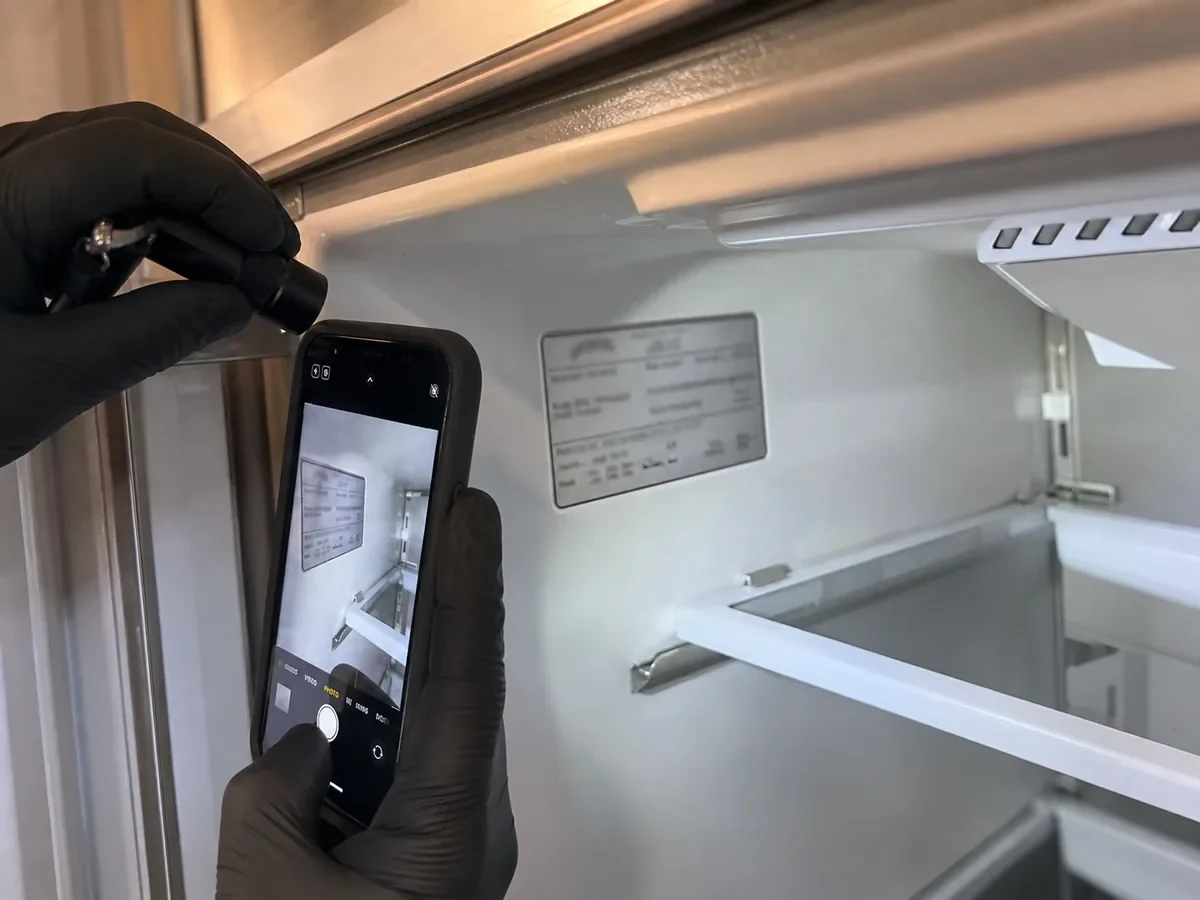
A photo of the model/serial tag (usually inside the door frame), a photo of the display reading, and — most useful of all — the set point versus what your own thermometer shows in the cabinet. That gap, plus when it started and whether it's steady or rising, lets us load the right OEM sensor, fan or board revision on the truck.
Local install reality · 04
Why Los Altos Hills wine columns drift the way they do
The homes nearer Foothill College — the 94022 and 94024 pockets where mid-century remodels sit beside newer integrated kitchens — tell the local story well. Many of these wine columns went in during a remodel five to fifteen years ago, set flush into custom cabinetry under oaks along the Page Mill climb. Two things follow from that. First, the same oak pollen and fine dust that loads kitchen condensers loads the wine unit's condenser too, and a paneled column hides the very grille that needs clearing — so the unit quietly works harder every summer until it can't hold the band. Second, because the cabinet is integrated, the early warning signs are invisible: you don't see a frost line or hear the fan the way you would on a freestanding fridge. By the time the display reads 59, the drift has usually been building for a season. That's why we log over a cycle here rather than reacting to one number — the install hides the history, so we have to recover it.
Evidence vs service · Two ways to read this · 05
What we measure, and what we actually do about it
The same drift, told two ways: the evidence a real diagnosis leaves behind, and how that evidence turns into a repair you approved before it started.
Evidence column
The proof we leave behind
A wine-column call should produce readings, not adjectives.
- Set point vs actual, logged over a cycle. Not a spot check — a trace of what the cabinet actually does as it cycles, so a sensor fault is told apart from normal door-open recovery.
- Thermistor resistance against the model's spec curve. A number we can show you, compared to what that sensor should read at that temperature.
- Evaporator-fan operation and airflow, watched through a full cycle, so a fan that surges or stalls under load is caught.
- Condenser photographed before and after clearing, so the dust load — the most common avoidable cause out along Page Mill — is documented, not described.
- Model/serial tag photographed so the part is matched to your exact unit, and the OEM fan, sensor or control-board packaging kept as evidence of what went in.
The diagram shows the refrigeration loop the wine unit shares with every Sub-Zero — useful context for where a sealed-system reading would come from, though on a wine column that's the rare exception, not the usual answer.

Service-explanation column
What that evidence becomes
Readings only matter if they change what we do next.
When a control board, thermistor or display alarm is the suspect, the evidence above is what keeps the repair honest. A noisy thermistor curve points us at the sensor before we ever touch the more expensive board; a board that ignores a good sensor signal is what justifies replacing it. We confirm the exact board revision against the model and serial — Sub-Zero revises these across production years — and order the OEM part for that serial, never a near-equivalent that drifts again next summer.
You get the readings before and after, a written quote before any work, and the part named on the invoice with a workmanship warranty on the repair. The image shows the model-specific diagrams we work from: the right sensor, fan or board for your serial, decided by the tag and the trace, not by an adjective. We don't use "best parts" language, because the serial number, not a word, picks the part.
Fremont Hills
Gated drives, recent remodels — paneled dual-zone columns; we plan the pull before touching the millwork.
Country Club
Established estates near the course — older 424/427 columns where serial-matched OEM parts matter most.
Hidden Villa area
Quieter rural parcels out toward Hidden Villa — long gate-to-door access; a confirmed window protects the half-day.
Page Mill corridor
Oak-shaded foothill homes — pollen and dust load the hidden condenser fast, so drift logged over a full cycle.


Step by step
Stop a Sub-Zero wine column from drifting off temperature
Log set point vs actual
Record the set point and an independent reading over a full cycle; a few degrees of drift is usually a sensor, not a dying cabinet.
Check the affected zone
On dual-zone units only the drifting zone’s thermistor or fan is usually at fault.
Clear the condenser
Foothill dust loads wine-unit condensers; a clean often restores temperature.
Match parts to serial
Wine sensors and fans vary by 424/427/430 revision and are matched to the tag.
Verify and price
Sensor recalibration runs $280–$560 and a zone fan $360–$740, after the $99 diagnostic.
Pricing
Sub-Zero wine column & dual-zone repair pricing in Los Altos Hills
| Service / symptom | What's included | Price range | Time |
|---|---|---|---|
| Diagnostic visit | Model/serial ID, temperature + airflow readings, written findings | $99 (credited to repair) | 45–90 min |
| Wine-zone sensor recalibration / replacement | Per-zone probe test, serial-matched sensor | $280–$560 | 1–2 hrs |
| Wine-zone evaporator fan | Airflow balance per zone, serial-matched fan | $360–$740 | 1–3 hrs |
| Control board (serial-matched) | Output test, serial-matched board, verification | $520–$850 | 1–4 hrs |
| Condenser deep-clean & airflow service | Pull-free coil clean, fan check, oak-pollen/dust removal | $230–$460 | 1–2 hrs |
What sets the final number: the exact model and serial revision, whether the unit must be pulled from its custom cabinet, and parts availability — all confirmed on site after the $99 diagnostic.
After you've watched it for a cycle, not before
Call or book online
Tell us the set point, what your own thermometer reads in the cabinet, and whether the drift is steady or climbing — then have the model/serial tag and display visible when you call or book online. We'll tell you the likely cause, the honest range, and whether it's a routine sensor fix or something that needs a closer look before any part is named.
Questions · 06
Wine-column drift questions we actually get in Los Altos Hills
My Sub-Zero wine column reads 59°F but I set it to 55 — is the wine ruined?
Almost certainly not. A steady few degrees above set point is well within the range wine tolerates short-term, and far better than any pantry shelf. The concern isn't the bottles, it's why the cabinet won't hold — usually a thermistor, evaporator fan or control board. Don't unplug it. Log the set point against your own thermometer for a day so we can tell a steady offset from a climbing reading.
Why does only one zone of my dual-zone Sub-Zero wine cabinet drift?
Dual-zone units run a separate sensor and airflow path per zone, so a single drifting zone usually points at that zone's thermistor or a fan not moving air evenly to it — not a whole-unit failure. We confirm by reading each zone's sensor against spec and watching airflow through a cycle, then replace only the part that's actually off, matched to your serial.
Is wine-column drift ever a sealed-system or refrigerant problem?
Rarely, and we verify before we ever say so. A drift of a few degrees is almost always a sensor, fan, board or seal. Sealed-system trouble shows up as the whole cabinet running warm with constant cycling, and any refrigerant work is EPA Section 608 — confirmed with gauges, not guessed. We rule out the simple, common causes first and only escalate with evidence.
What's the most useful thing to have ready before the visit?
The gap between your set point and what an independent thermometer reads inside the cabinet, plus when it started and whether it's steady or rising. Add a photo of the model/serial tag inside the door frame and the display. That lets us match the exact OEM sensor, fan or control-board revision for your unit and bring it on the first visit rather than ordering after.
Is a few degrees of drift in my Sub-Zero wine column dangerous to the wine?
Rarely. A column set to 55 °F reading 58–61 °F is still protecting bottles far better than a pantry, and a steady offset is usually a thermistor or fan, not a dying cabinet. Sensor recalibration runs $280–$560. Move irreplaceable bottles only if the temperature is climbing, not just steadily offset.
Does summer heat in Los Altos Hills push a wine column off temperature?
It can. Foothill summer heat plus a dust-loaded condenser make a wine unit work harder, and a struggling evaporator fan or sensor then shows as a 3–6 °F drift. A condenser clean ($230–$460) often restores it; if a zone fan or sensor is the cause, that runs $360–$740 or $280–$560 after the $99 diagnostic.

Keep reading
Where to go next
Local review signal
Google review highlights for Sub-Zero wine column and dual-zone temperature repair in Los Altos Hills
Owners usually care about the same three things: careful diagnosis, protected cabinetry and a quote that follows evidence.
Dual-zone 430: only the lower zone drifted to 61 °F. The evaporator fan wasn't moving air evenly; replaced for $480 in about two hours. Careful work around the panel.
Homeowner, Country ClubA Designer wine unit crept 6 °F off set point. The condenser was dust-loaded from the foothills; a deep clean plus sensor check restored it for $290. Stable ever since.
Homeowner, near Foothill College