
Climate care field guide · Making noise
A new noise from your Sub-Zero — what the sound is actually telling you
In a town this quiet, a refrigerator gives itself away. There is little traffic to mask it, the great-room kitchens common here put the unit in the same open volume as the living space, and hard stone and plaster surfaces bounce the sound back, so a hum that a noisy condo would swallow becomes the thing you notice at midnight. The good news: the character of the noise — a buzz, a hum, a rattle, a groan — usually names the part before anyone opens a panel.
Some Sub-Zero sounds are normal: the soft whir of fans, the tick of a defrost cycle, the gurgle of refrigerant settling, a brief louder run after the door's been open. What's worth a closer look is a noise that is new, getting louder, or coming from a specific spot — and especially one that arrives alongside warming food, which moves it from annoyance to diagnosis.
Why is my Sub-Zero making a loud noise in Los Altos Hills?
Los Altos Hills Sub-Zero Repair identifies most refrigerator noise by its character and location: a buzzing or rattling condenser fan loaded with foothill dust, an evaporator fan ticking against ice, a compressor groan, or a vibrating drip pan or panel. New, rising or localized noise — especially with warming food — is worth a diagnostic. Call (650) 668-1043.
Flat $99 diagnostic, credited toward an approved repair.
Direct answer
Most Sub-Zero noise in Los Altos Hills traces to a few sources: a condenser fan buzzing or rattling against dust and debris behind the top grille, an evaporator fan ticking where its blade catches ice, a compressor groaning as mounts age, or a loose drip pan or panel buzzing in sympathy. The character of the sound and its location name the part. Noise on its own is often a $200–$650 fan or mount repair; noise with warming food is a cooling fault and more urgent. A flat $99 diagnostic pins the source, credited toward the repair.
- Foothill lots load condenser fans fast — oak pollen, fine dust off long gravel and decomposed-granite drives, and leaf litter turn a smooth fan into a buzz or rattle.
- Open great-room kitchens with stone and plaster surfaces amplify a hum that a smaller, softer room would hide, so owners here notice changes early.
- Noise without any warming is usually a fan, mount or panel — $200–$650; noise with a warm compartment is a cooling fault and should be diagnosed promptly.
Name the sound · 01
Buzz, hum, rattle, groan — each points somewhere different
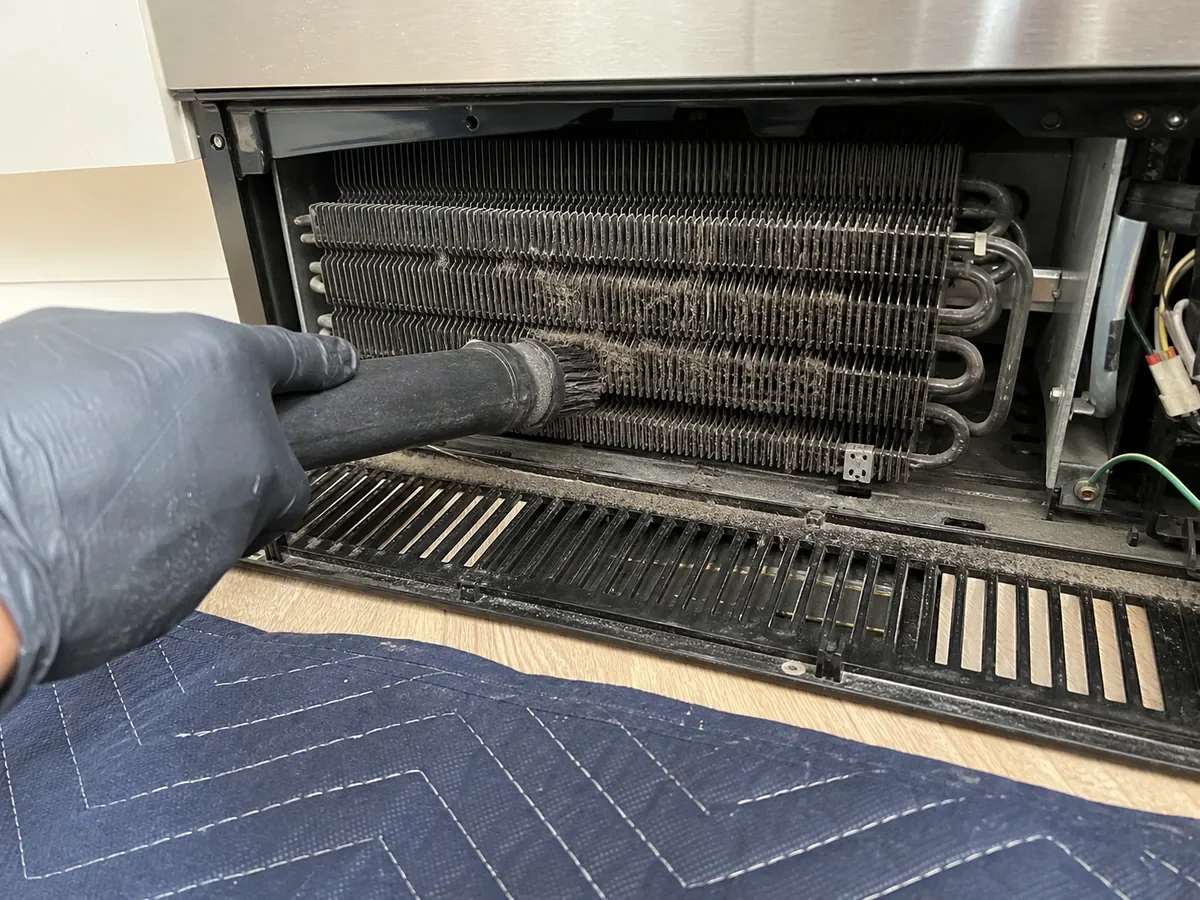
A buzz or rattle that rises and falls and seems to come from the top grille is almost always the condenser fan. It spins in the dustiest part of the machine, and when its blade loads with debris, a bearing dries out, or something light drops into its path, it clatters. A rhythmic tick or chirp from inside the cabinet is usually the evaporator fan brushing a ridge of ice — which means a defrost issue is letting frost build where it shouldn't, and the noise is really a cooling problem announcing itself early.
A low hum or groan, felt as much as heard, comes from the compressor. A steady hum is normal; a new, louder groan or a knock at start-up points to aging mounts or a hard-starting compressor and deserves a look before it worsens. A vibration or buzz that you can stop by pressing on a panel is exactly what it sounds like — a loose drip pan, a grille, or a panel-ready front resonating with the compressor — harmless to the machine but maddening in a quiet house, and a five-minute fix once we find it.
Why the foothills make it worse · 02
Dusty drives, quiet rooms, and an open-plan kitchen
Two local facts turn a minor noise into a service call here. First, the condenser fan loads faster on these lots than almost anywhere in the valley: the oak canopy drops pollen for weeks, long gravel and decomposed-granite drives kick fine grit toward the grille, and that debris is exactly what unbalances a fan into a buzz. The same dust that makes a Sub-Zero run warm out here also makes it loud, which is why a periodic condenser clean does double duty — it's the cheapest thing on our maintenance calendar.
Second, the rooms are quiet and open. A great-room kitchen puts the refrigerator in the same volume as the seating area, with stone counters, tile or plank floors and plastered walls that reflect rather than absorb, and the foothill setting has almost no background traffic to cover it. A hum that would vanish in a busy household is the loudest thing in the room here at night — so owners catch a developing fan or mount problem early, which is genuinely good: caught early, most noise is a small repair.
Noise that is really a warning · 03
When a sound means the food is at risk
The line that matters: a noise with no temperature change is usually a comfort problem — a fan to balance, a mount to replace, a panel to secure. A noise that arrives with warming food, longer run times, or frost where there shouldn't be any is a cooling fault wearing a sound, and it should be diagnosed promptly. An evaporator fan ticking on ice means defrost trouble; a condenser fan that has seized rather than just buzzed means the unit can't shed heat and will warm; a compressor that groans and then warms both compartments is the one to take seriously.
That's where this page hands off. If the noise comes with a warm fresh-food side, read the not-cooling diagnostic; if it's the freezer losing its hold, see freezer not freezing; and if a deep groan rides with both sides warming, that's the sealed-system and compressor path, where we verify with gauges under EPA Section 608 rules before anyone quotes a compressor. We won't sell you a compressor for a buzz.
| Sound & location | What it usually is | How we confirm it | Typical repair |
|---|---|---|---|
| Buzz / rattle from the top grille | Condenser fan loaded with dust or a dry bearing | Pull the grille, inspect and spin the fan, read its draw | Clean or replace condenser fan; $200–$520 |
| Vibration you can stop by pressing a panel | Loose drip pan, grille or panel-ready front resonating | Locate the buzzing part, secure or isolate it | Secure panel / pan; $120–$280 |
| Rhythmic tick or chirp inside the cabinet | Evaporator fan brushing ice from a defrost fault | Inspect the coil for ice; test the defrost system | Clear ice + defrost repair; $340–$700 |
| Low groan or knock at start-up | Aging compressor mounts or a hard-starting compressor | Read start behavior and electrical, check mounts | Mounts / start component; $260–$650 |
| Loud hum with both sides warming | A sealed-system or compressor fault under strain | Gauge readings under EPA Section 608 by a qualified tech | Sealed-system work; $1,400–$2,900 |
Step by step
Pin down a noisy Sub-Zero before you call
Name the sound
Decide whether it is a buzz, a hum, a rhythmic tick, or a groan — and whether it rises and falls or holds steady. The character is half the diagnosis.
Locate it
Listen at the top grille, then at the cabinet interior, then low at the compressor. A sound from the grille is usually the condenser fan; from inside, the evaporator fan.
Test the panel theory
Gently press on the lower grille, the kick panel and any loose trim while it runs. If the noise stops, it is a resonating panel or drip pan, not a failing part.
Check for warming
Put a thermometer in each compartment. Noise with warming food is a cooling fault and more urgent than noise alone.
Book with details
Call or book online with the sound, its location and both temperatures, plus the model and serial. The $99 diagnostic pins the source and is credited toward the repair.
The vast majority of Sub-Zero noises are fans, mounts or loose panels — small repairs. We will not quote a compressor from a description of a sound. The only noise that points at the sealed system is a deep groan that rides with both compartments warming, and even then we confirm with gauge readings under EPA Section 608 rules before any quote. If your unit is loud and warm, start with the not-cooling diagnostic.
After you've matched the symptom, not before
Call or book online
Call or book online with the sound — buzz, hum, tick or groan — where it comes from, and whether any compartment is warming, along with the model and serial. That lets us bring the right fan, mount or panel hardware and usually quiet the unit on the first visit.
FAQ
Noise questions we get in Los Altos Hills
Is it normal for a Sub-Zero to make noise?
Some sounds are normal — the soft whir of fans, a defrost tick, refrigerant gurgle, and a louder run after the door has been open. What is worth checking is a noise that is new, getting louder, coming from one spot, or arriving with warming food. In the quiet of a Los Altos Hills home those changes are easy to catch early.
My Sub-Zero is buzzing loudly from the top — what is that?
A buzz or rattle from the upper grille is almost always the condenser fan. On foothill lots it loads quickly with oak pollen and the fine grit off gravel drives, which unbalances the blade, and a dry bearing adds to it. Pulling the grille to clean or replace the fan usually solves it — and a clean condenser also keeps the unit from running warm.
There is a rhythmic ticking inside the fridge — should I worry?
A rhythmic tick or chirp from inside the cabinet is usually the evaporator fan blade brushing a ridge of ice, which means frost is building where it should not — a defrost issue. It is best treated as an early cooling warning: have it checked before the ice chokes airflow and a compartment warms.
Can a loud noise mean the compressor is failing?
Sometimes, but rarely on its own. A low groan or a knock at start-up can point to aging compressor mounts or a hard start. The noise that actually signals a sealed-system or compressor problem is a deep groan that comes with both compartments warming. We verify that with gauge readings under EPA Section 608 rules before ever quoting a compressor — we will not sell one for a buzz.
A buzz stops when I press on the lower panel — is that a real fault?
No — that is a resonating part, not a failing one. A loose drip pan, lower grille or panel-ready front can vibrate in sympathy with the compressor and buzz against the cabinetry. It is harmless to the machine and a quick fix once we find which panel is doing it, which matters a lot in a quiet open-plan kitchen.
Keep reading