Fresh-food side on our BI-36 climbed to 47 °F while the freezer held. They confirmed the model and serial, measured both compartments and replaced a stalled evaporator fan motor for $610, about two hours. A repair, not a replacement pitch.
Homeowner, Country ClubCore service · Sub-Zero repair · Los Altos Hills
Your Sub-Zero is drifting warm — does it need a repair, or a replacement?
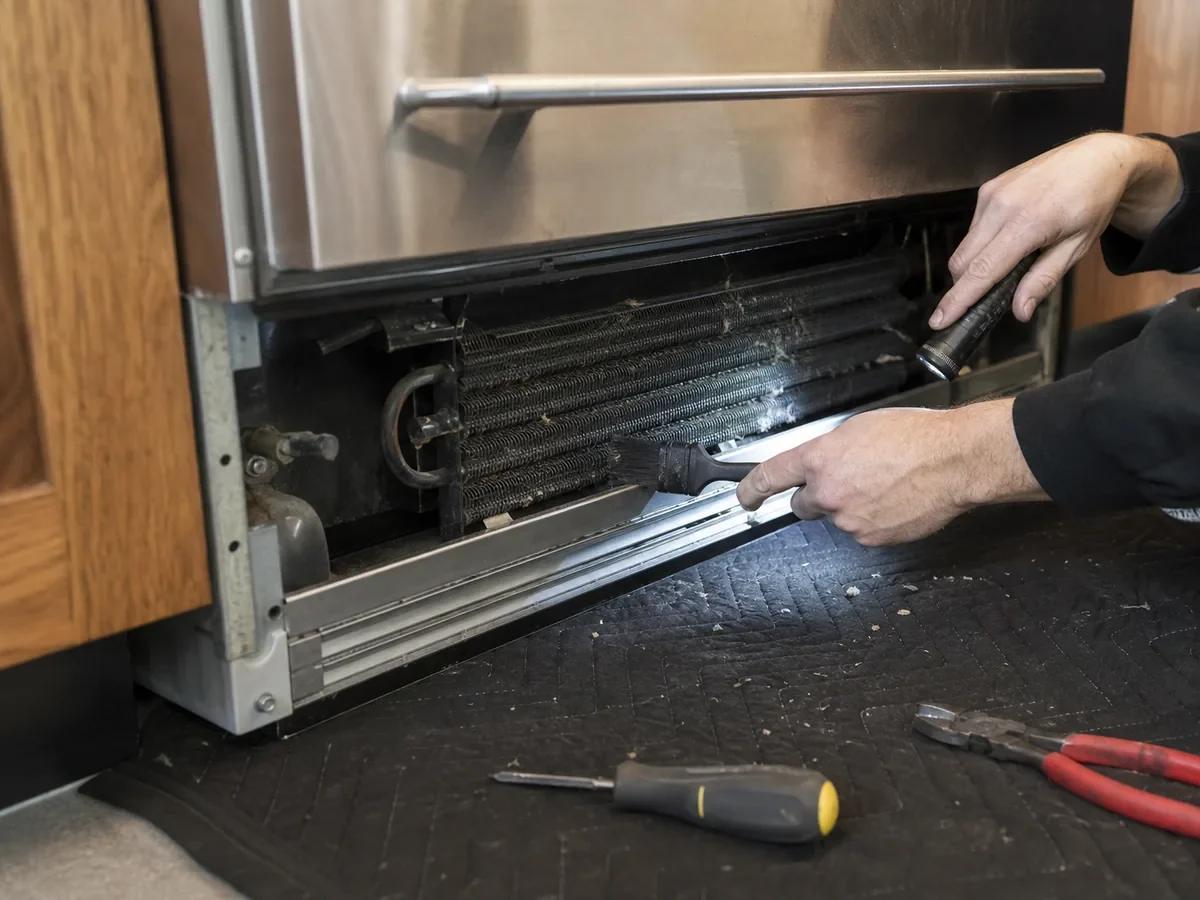
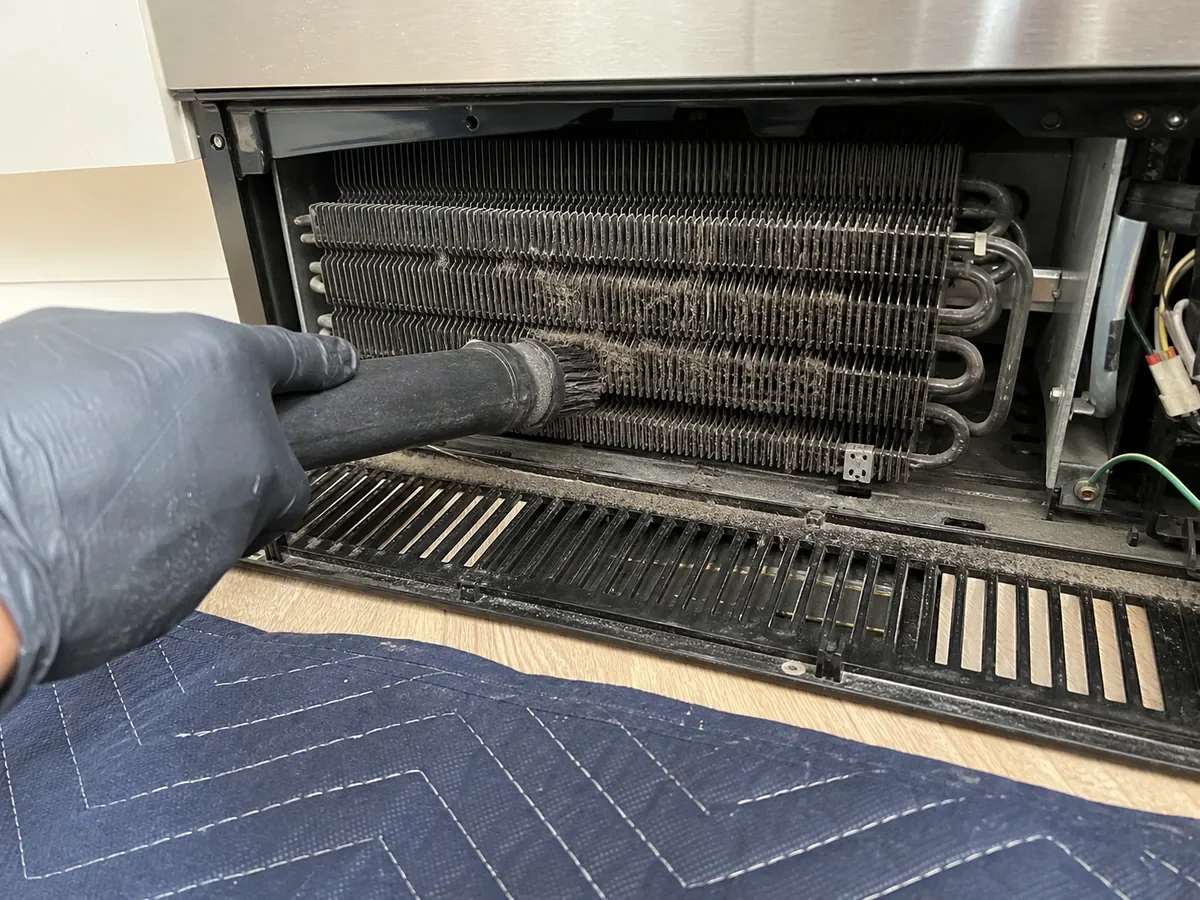
If a built-in Sub-Zero in Los Altos Hills is slowly losing its hold — the fresh-food side creeping warm, the compressor running longer, the kitchen warmer near the grille — the first thing we check is the condenser coil, often packed with dust or pet hair. On the wooded parcels out toward the Hidden Villa area that coil clogs faster than almost anywhere, and a smothered condenser mimics a far more expensive failure. We are a Sub-Zero-focused service. We confirm the model and serial, measure both compartments, and photograph the coil before we name a single part — so you decide repair or replace on evidence, not a sales pitch.
Flat $99 diagnostic, credited toward an approved repair.

Work-process photo: lower access open, tools and floor protection visible.
Direct answer
Los Altos Hills homeowners reach a Sub-Zero-focused technician for built-in refrigerators, integrated columns, freezer drawers, undercounter units and wine storage. A flat $99 diagnostic is credited toward any approved repair. Most repairs run $300–$850; sealed-system or compressor work on a column can reach $1,400–$2,900. Parts are genuine OEM, matched to your model and serial, with a written quote before any work. The exact figure is confirmed on site after diagnosis — never quoted blind over the phone.
- Sub-Zero repair planning ranges in Los Altos Hills: $99 diagnostic (credited), $300–$850 for most non-sealed repairs, and $1,400–$2,900 for confirmed sealed-system or compressor work.
- We service BI-36/42/48 built-ins, 648PRO side-by-sides, Designer columns, 424/427/430 wine units and UC undercounters across 94022 and 94024.
- Genuine OEM parts are matched to the model and serial; the invoice names the part, the labor and a workmanship warranty.
Service scope · What we work on · 02
The Sub-Zero families we service — and the failure each one tends to show
We don't service "all appliances." We service Sub-Zero cold-side equipment, deeply. Here is what we cover and the symptom we see most on each, so you can place your unit before you call.
| Sub-Zero family | What it is | Common failure we see | Usually points to |
|---|---|---|---|
| Classic / BI built-ins | Side-by-side and over-and-under built-ins, dual refrigeration | Fresh-food side warm while the freezer still holds | Evaporator fan, frosted coil or a thermistor — rarely the compressor |
| Designer integrated columns | Panel-ready all-fridge or all-freezer columns | Condenser coil packed with dust or pet hair | Restricted airflow; clean and re-measure before naming parts |
| PRO 48 / pro built-ins | Stainless pro-style built-ins with glass or solid doors | Long run times, warm zones, loud condenser fan | Condenser fan, airflow restriction or a sealed-system check |
| Undercounter UC units | Drawer and door refrigerators, freezers, ice makers | Ice maker slow, jammed or producing hollow cubes | Fill tube, inlet valve, filter age or the ice module |
| Freezer drawers | Built-in lower freezer drawers and tall freezer columns | Frost build-up, drawer not sealing, ice on the gasket | Door gasket leak, alignment or a defrost component |
| 424 / 427 / 430 wine units | Single- and dual-zone wine columns for collectors | Wine column drifting several degrees off set point | Thermistor, evaporator fan or a control reading the cabinet wrong |
| Any built-in / column | Across families when the door sweats or frosts | Door gasket leak, condensation or a frost line | Hardened or torn gasket, or a panel-ready door out of alignment |

Read the symptom · 03
A frost line or a sweating door is a leak you can usually see
A door gasket leak shows up as condensation or a frost line long before the food is at risk. Warm, humid room air is slipping past a hardened, torn or pinched gasket — or past a panel-ready door that has drifted out of alignment behind its custom front — and the moisture condenses, then freezes, where the warm air meets the cold cabinet. You'll notice a sweating door, a thin rib of frost along one edge, or water tracking down the inside. Diagnosis confirms which it is: we run a gasket seal check, look at door alignment and hinge wear, and watch where the frost forms over a cycle. A gasket that fails the seal test gets replaced; a door that's simply out of square gets reseated.
The honest limit: a frost line on a Sub-Zero isn't always the gasket. The same symptom can come from a defrost component or a sensor letting the coil ice over and push cold air to the wrong place. We can rank the likely cause from your call or online booking details, but we can't confirm gasket versus defrost until we measure on site — so we tell you that up front instead of pre-selling a gasket kit.
Why the seal matters
Where a gasket leak starts
A Sub-Zero gasket is a magnetic seal with an air channel inside it. When it hardens or tears, the magnet still grabs but the channel no longer compresses — so a hairline gap lets room air in along one edge. That single gap is enough to lay down a frost line and load the system with humidity.
The fix is rarely dramatic. But proving it is the point: a gasket that passes a seal test shouldn't be replaced just because the door sweats, and a door out of alignment won't be fixed by a new gasket at all. We test before we swap.
Local install reality · 04
How the Page Mill corridor and the foothills change the call
Los Altos Hills isn't one kind of house, and the differences are mechanical, not cosmetic. Where you are changes access, the age of the install, and the load on the equipment — so it changes the repair plan.
Foothill homes along the Page Mill corridor sit under oaks on steep, often gated drives. Two things follow from that. First, access: a confirmed arrival window matters when the gate code, the long approach and the narrow service path all have to line up before a built-in can be pulled — we plan the pull before we touch the unit, because the cabinetry here is custom and unforgiving. Second, climate load: the same oaks that make these lots beautiful throw pollen and fine dust at exposed condenser coils, so a Page Mill condenser packs faster than one in the flats. That single factor drives more "fresh-food side warm" calls on this route than any failed part.
Down toward Fremont Hills, ambitious remodels favor full panel-ready suites, so a diagnosis has to respect new millwork — the appliance is part of the cabinetry, not bolted in front of it. Near the Country Club stretch, the Sub-Zero is often a Classic that has run fifteen-plus years; those units reward genuine, serial-matched parts that are no longer the obvious off-the-shelf choice. And in the newer integrated kitchens nearer Foothill College, the model tag — not the address or the finish — is what tells us which board revision and which fan we're actually working on. We ask for it up front for exactly that reason.
Diagnostic workflow · Our sequence · 05
How a visit runs — booking details to verified fix
Every step produces a reading or a photo, so the diagnosis is something you can see rather than take on faith.
Booking details by symptom
You describe what the unit is doing and when it started. We ask for the model and serial so the right parts and tools are on the truck for your exact revision.
Confirm model & serial in person
We read the tag ourselves — Classic, Designer, PRO, undercounter and wine units behave differently, and the serial dates the sealed system and board revisions.
First measurement before anything is touched
Temperature in both compartments, airflow at the evaporator, and a look at the condenser and its coil — a packed coil is checked first because it's the cheapest fix and the most common cause.
Isolate the likely part by test
Fan, sensor, defrost component, gasket, inlet valve, control board or sealed system — narrowed by reading and meter, not by guess.
Written quote, parts and labor
In writing before work begins. The $99 diagnostic is credited toward the repair you approve, so the visit pays for itself if you move ahead.
Repair with serial-matched OEM parts
Genuine parts matched to your serial, installed to factory spec, with the surrounding cabinetry protected during any pull.
Verify and document the fix
We re-measure both compartments, watch a cycle where time allows, and photograph the result so you can see the unit holding temperature again.
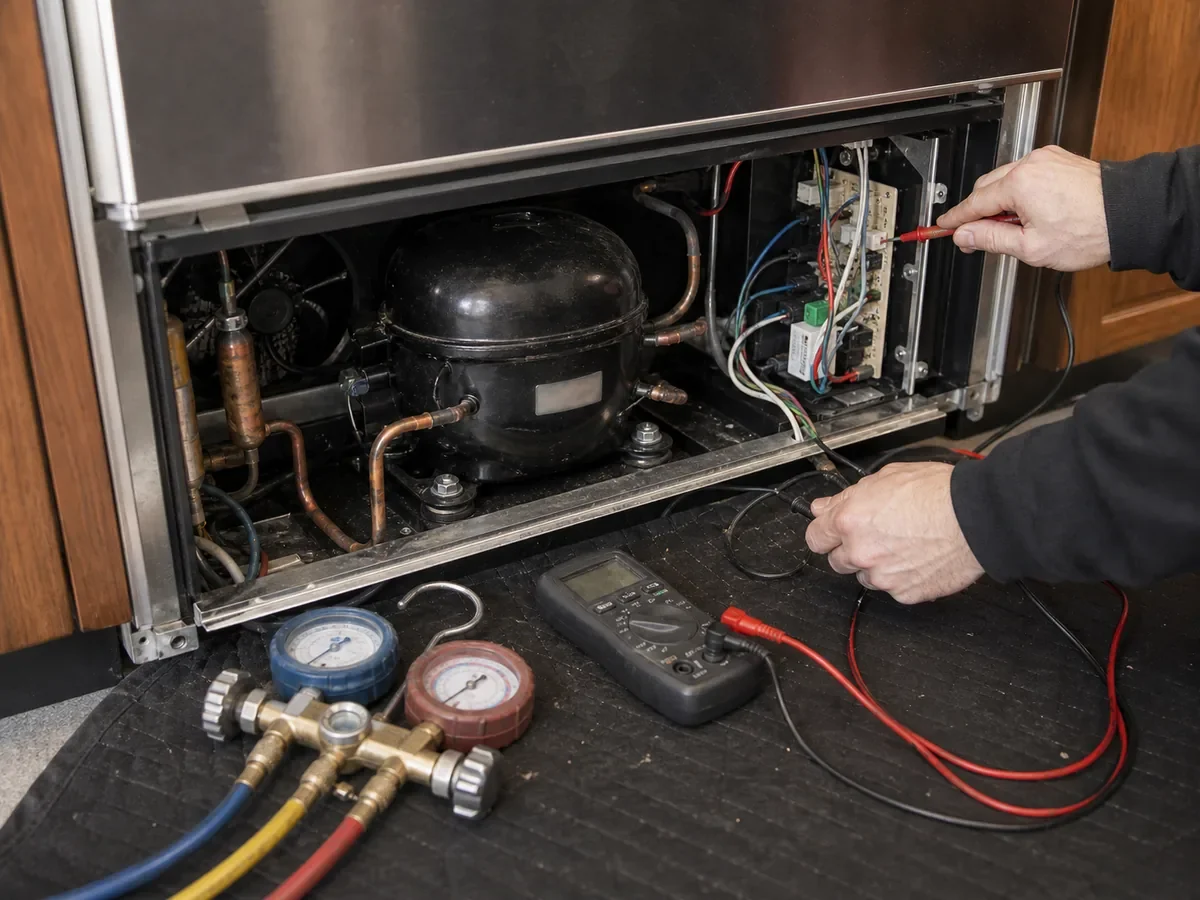
For sealed systems, compressors, control boards and any gas-valve or refrigerant work, we verify before we quote. These are the failures where a wrong guess costs the most — so we confirm with gauges, meter readings and a model-specific check, or we tell you it needs a specialist step, rather than swapping a $1,400 part and hoping. Refrigerant work is performed under EPA Section 608 rules; we don't open a sealed system to "see."
Pricing · Cost & economics · 06
What Sub-Zero repair costs — and when replacement is the honest call
Ranges, not blind quotes. The exact figure comes after the on-site diagnosis; here's the shape of it so there are no surprises.
Diagnostic visit
A flat $99 on-site diagnostic, credited toward any approved repair. You get temperature readings and condenser photos either way — the visit produces evidence, not just an opinion.
Most repairs
$300–$850 covers the bulk of what we see: evaporator and condenser fans, thermistors, gaskets, defrost components, inlet valves and ice modules. Parts and labor in writing before work starts.
High-end exception
Sealed-system or compressor work on a column can reach $1,400–$2,900. This is the one band where verification comes before any quote — and where repair-versus-replace deserves a real conversation.
Repair or replace · 06b
When the math favors keeping the unit
For most Sub-Zero failures, repair wins decisively: a Classic built-in is engineered for twenty-plus years, and a fan, gasket, thermistor or board on a sound sealed system is a fraction of replacement plus the cabinetry rework a swap forces in a panel-ready kitchen. The cost of a new column is rarely the whole cost — pulling and refitting custom millwork can rival the appliance. That's why "just replace it" is the expensive default here, not the safe one. We don't pretend repair always wins, though: when a sealed system on an aging unit fails and the surrounding parts are tired, we'll say replacement is the sounder spend and explain why. The diagnostic is what tells the two apart, and it's the same $99 either way.
Evidence · Proof · 07
What a real Sub-Zero diagnosis leaves behind
A scenario, the parts we work from, and the documentation you keep. Photos here are illustrative context, not claims about a specific completed job.
Picture a ridge home off Altamont Road with a steep drive and a dual-zone wine column — the kind of install where temperature stability is the point. The owner reports the cabinet drifting a few degrees warm over a hot week. The cheap, wrong move is to condemn the sealed system. The honest path: log set point against actual temperature over a full cycle, check the evaporator fan and thermistor, and confirm the condenser isn't smothered by the dust these ridge lots collect. More often than not on Altamont, drift like that resolves at the fan or the coil, not the compressor — but we log it before we name it. This is a representative scenario, not a record of a specific customer's repair.


The high-stakes path
Sealed-system suspicion needs qualified sealed-system verification
When both compartments run warm and the compressor never seems to rest, a sealed-system or compressor fault is on the table — and it's the one diagnosis we refuse to guess. Before any quote in this band we gather real evidence: temperature readings in both compartments, condenser and evaporator photos showing frost pattern and coil condition, model-tag proof so the sealed-system and board revision are correct, and OEM fan, gasket and control-board evidence to rule out the cheaper causes first.
Only after the simpler suspects are eliminated do we put gauges on the system under EPA Section 608 rules. If the verification points to a sealed-system or compressor repair, you get the reading and the range in writing — and an honest take on whether that spend makes sense for your unit's age and the cabinetry around it.
You leave a repair with a record, not a promise: the model and serial, before-and-after temperatures, condenser and evaporator photos, and the exact OEM part fitted, named on the invoice alongside the labor. A workmanship warranty covers the repair itself. We don't use "best parts" language because the serial number — not an adjective — decides the correct part for your unit.
Pricing
Sub-Zero repair pricing in Los Altos Hills by symptom
| Service / symptom | What's included | Price range | Time |
|---|---|---|---|
| Diagnostic visit | Model/serial ID, temperature + airflow readings, written findings | $99 (credited to repair) | 45–90 min |
| Condenser deep-clean & airflow service | Pull-free coil clean, fan check, oak-pollen/dust removal | $230–$460 | 1–2 hrs |
| Door gasket / seal replacement | Serial-matched gasket, seat and leak test | $300–$640 | 1–3 hrs |
| Ice maker module / fill tube / inlet valve | Fill-volume test, valve or module, line clear | $300–$720 | 1–3 hrs |
| Evaporator fan motor | Serial-matched fan motor, airflow verification | $360–$740 | 1–3 hrs |
| Thermistor / temperature sensor | Resistance test, serial-matched sensor, recalibration | $280–$560 | 1–2 hrs |
| Control board (serial-matched) | Output test, serial-matched board, verification | $520–$850 | 1–4 hrs |
| Refrigerant leak + recharge (EPA 608) | Leak isolation, repair, evacuate and weighed charge | $1,400–$2,100 | 3–6 hrs |
| Compressor replacement | Sealed-system pull, compressor, filter-drier, recharge | $1,900–$2,900 | 4–8 hrs + parts |
What sets the final number: the exact model and serial revision, whether the unit must be pulled from its custom cabinet, and parts availability — all confirmed on site after the $99 diagnostic.
After the diagnosis, not before
Call or book online
Tell us what your Sub-Zero is doing — warm side, frost line, slow ice, a drifting wine column — and have the model/serial tag ready when you call or book online. We'll tell you the likely path and the honest range before anyone schedules a truck. Repair or, when it's genuinely the better spend, replacement.
Questions · 08
Sub-Zero questions we actually get on this page
My Sub-Zero runs constantly and the kitchen feels warm near the grille — is the compressor dying?
Usually not. The first suspect is a condenser coil packed with dust or pet hair, which is common on the oak-shaded lots out toward Page Mill and Hidden Villa. A smothered coil makes the system run nonstop and warms the air near the grille, mimicking a sealed-system fault. We clean and re-measure airflow before anyone says "compressor."
How fast can a frost line or a sweating door actually hurt my food?
A gasket leak shows as condensation or a frost line well before the food is at risk — it's an early warning, not an emergency. The moisture is the symptom; the gap in the seal is the cause. Keep using the unit, note where the frost forms, and we'll confirm whether it's the gasket, the door alignment, or a defrost component before it loads the system.
Do you replace the whole column, or can you save the cabinetry?
Saving the cabinetry is the core skill on these homes. Most failures — fans, thermistors, gaskets, boards — are repaired with the unit in place or a careful, planned pull that protects the panel-ready fronts. We plan the pull before touching the unit and reseat custom fronts to alignment, which is exactly why we ask for the model up front.
Is it worth repairing a fifteen-year-old Sub-Zero, or should I replace it?
Often it's worth repairing — Classic built-ins are engineered for twenty-plus years, and a fan, gasket or board on a sound sealed system costs a fraction of replacement plus the cabinetry rework a swap forces. When a sealed system fails on a tired unit, we'll say replacement is the sounder spend and explain why. The $99 diagnostic is what tells the two apart.
How long does a typical Sub-Zero repair take in Los Altos Hills?
Most fan, gasket, sensor, ice or control repairs are completed in a single 1–4 hour visit once the serial-matched part is on hand. Sealed-system or compressor work runs 3–8 hours plus parts. We bring likely parts by reading your model and serial in advance, so foothill homes rarely need a second trip.
Do you work on Wolf or Cove appliances too?
Our focus is Sub-Zero cold-side refrigeration, but we triage Wolf built-in ovens and Cove dishwashers found in the same Los Altos Hills estate kitchens. Refrigeration repairs — built-ins, columns, wine units and ice makers — are where our diagnostic depth and serial-matched parts give the most reliable result.
Keep reading
Where to go next
Local review signal
Google review highlights for Sub-Zero built-in, column and wine-unit repair in Los Altos Hills
Owners usually care about the same three things: careful diagnosis, protected cabinetry and a quote that follows evidence.
The $99 diagnostic was credited toward a $300 door-gasket repair on our 648PRO. Genuine serial-matched parts, a written quote before any work, and the gated driveway handled without fuss.
Homeowner, Fremont HillsOur 424 wine column drifted to 59 °F set at 55. They logged set point against a probe over a full cycle, then recalibrated and replaced the thermistor for $340. Careful around the panels, clear readings.
Wine collector, Altamont ridge