
★★★★★
We put our two BI-36 units on a twice-a-year condenser clean, timed for right after the oak-pollen season. The warm-side calls we used to get every summer have stopped completely.
Harold C., Homeowner, Matadero HillsClimate care field guide · Los Altos Hills
Most Sub-Zero failures we see in Los Altos Hills — a door gasket leak, a sweating panel or a frost line creeping along a column seal — start months earlier as upkeep that quietly slipped. Out toward Hidden Villa, where a built-in may run untouched behind matched cabinetry for a year, small drift goes unnoticed until the fresh-food side warms. This page is the calendar we wish every owner had: what to clean, when to check, and the point where a hum or a frost edge stops being maintenance and becomes a diagnosis.
Flat $99 diagnostic, credited toward an approved repair.
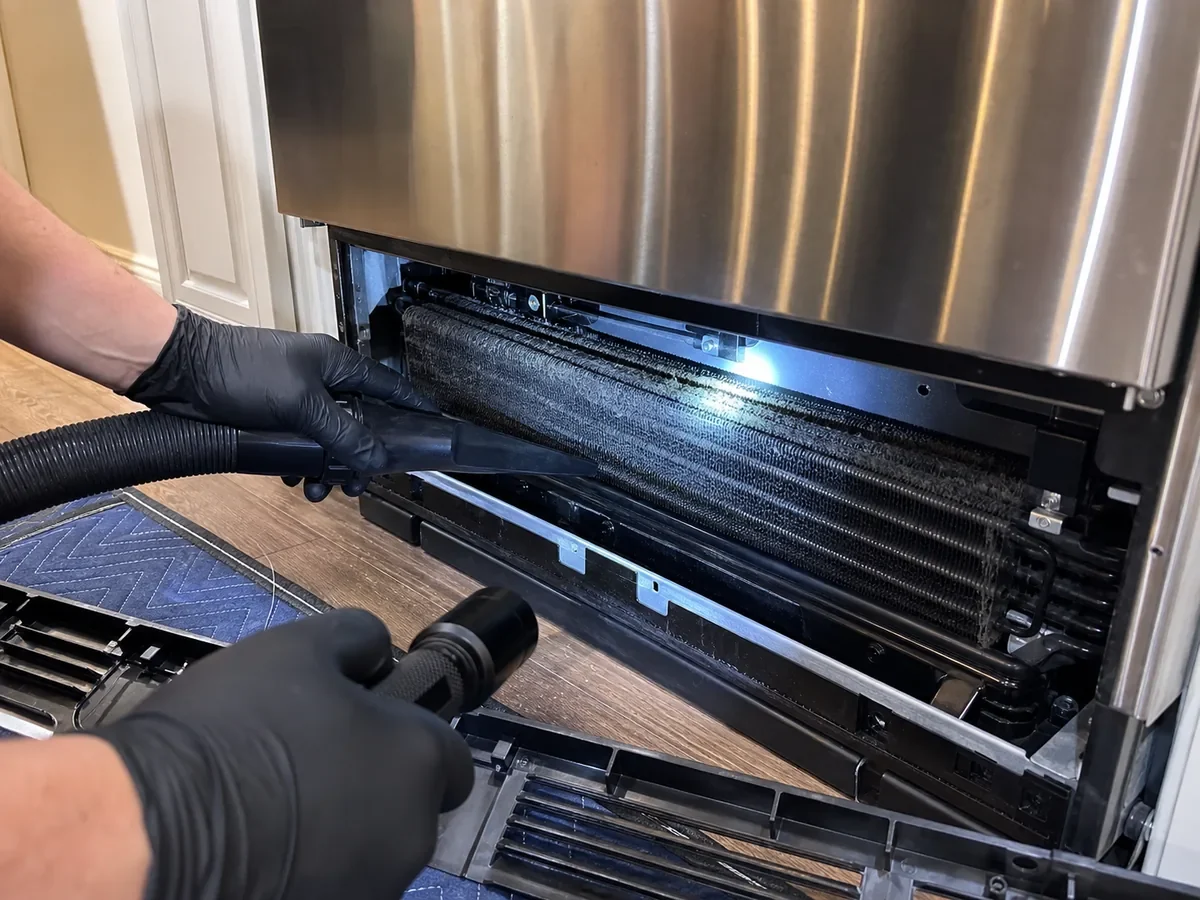
Condenser maintenance: brush, vacuum and flashlight access.
Direct answer
For a Sub-Zero built-in in Los Altos Hills, plan on cleaning the condenser roughly every six months — and closer to every four along the oak-shaded Page Mill foothills, where pollen and fine dust pack a coil fast. Wipe and inspect the door gasket monthly, change the water filter about every six months, and log a wine column's set point against actual temperature twice a year. Those four habits prevent most warm-side and frost-line calls. Anything involving sealed-system pressures or refrigerant is EPA Section 608 work and not an owner task. A flat $99 diagnostic is credited toward any approved repair; most repairs run $300–$850, exact quote after on-site diagnosis.
Seasonal schedule · The calendar · 01
Integrated cabinetry, panel-ready columns and a long pollen season change the timing. The table below ties each task to how Sub-Zeros are installed and used in the foothills — high-use built-ins, concealed grilles, and the Page Mill oak dust that loads coils ahead of schedule.
| Month / season | Primary task | Why this timing here |
|---|---|---|
| January – February | Post-holiday condenser clean + gasket wipe | Holiday entertaining drives weeks of heavy door cycling; the grille on a panel-ready column hides how much dust packed in over the season. |
| March – April | Pre-pollen condenser clean + airflow check | Page Mill oaks release pollen early; clearing the coil before the heavy drop keeps the fresh-food side from drifting warm in late spring. |
| May – June | Water filter change + ice-maker fill check | Six-month filter interval lands here; rising water use through summer makes a tired filter or kinked fill tube show up as slow or hollow cubes. |
| July – August | Wine column drift log + door-seal inspection | Warm room air stresses the seal on a concealed door; a collector's column should be logged set-point vs actual before drift becomes a worry. |
| September | Second condenser clean (post-pollen) | By early fall the spring pollen has fully settled into the coil; this is the year's second mandatory clean for homes under the oak canopy. |
| October – November | Frost-line + gasket check before heavy use | Catch a hardening gasket or early frost line before the holidays load the built-in — a worn seal is a quiet repair now, a warm box in December. |
| December | Light gasket clean + leave the diagnostics to a visit | Peak door-cycling month; keep gaskets clean and watch for sweating panels, but defer any condenser pull or sealed-system suspicion to a scheduled call. |
| Every 6 months | Model/serial-matched filter + alignment glance | Panel-ready doors drift out of alignment over a year; a quick reseat glance protects the seal and the millwork it sits against. |
Six Sub-Zero tasks · Task by task · 02
Each task is split into the part an owner can safely handle and the line where a built-in needs a technician. Sub-Zeros reward this split: half of these are simple habits, half touch sealed systems or cabinetry you don't want to improvise on.
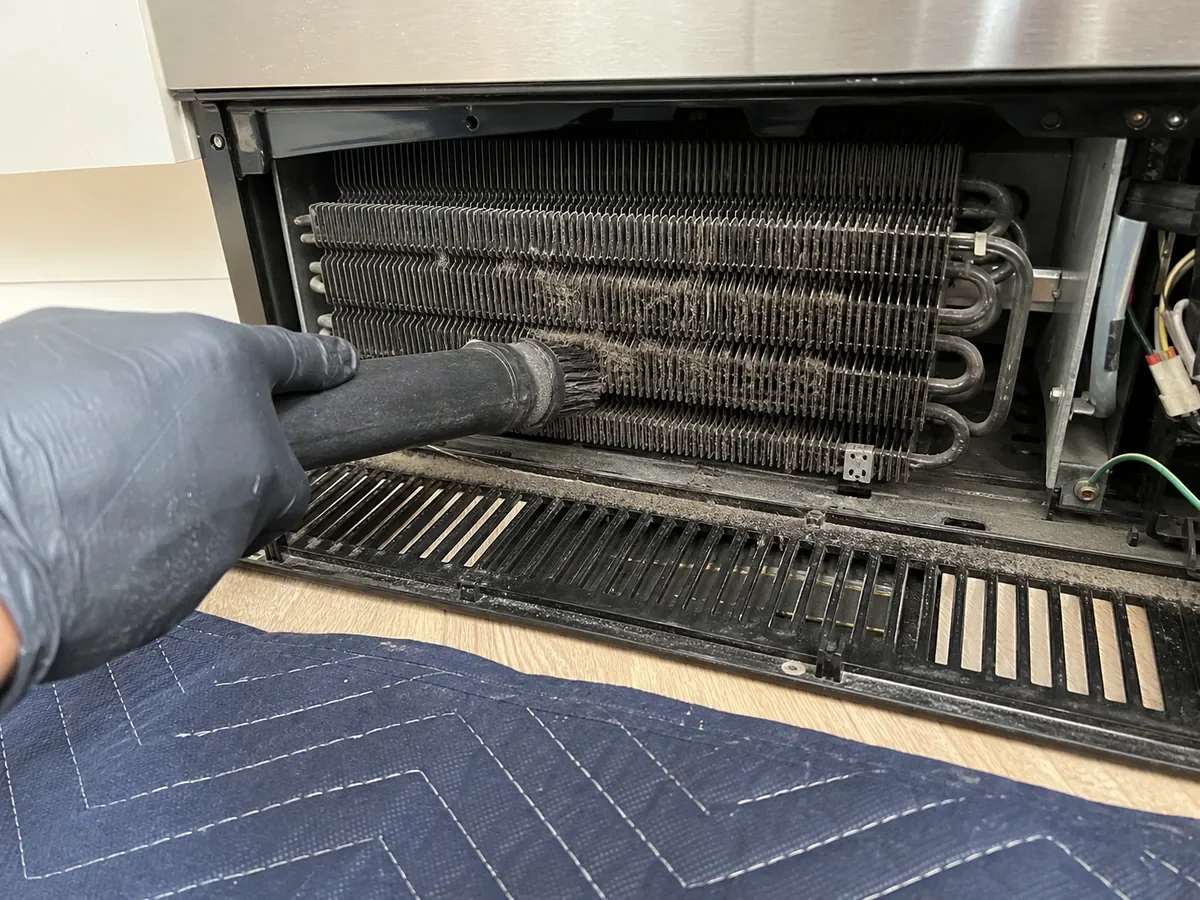
Why it matters: a coil packed with Page Mill pollen and dust makes the compressor run hot and long, the classic path to a warm fresh-food side. What you can do: on most built-ins, remove the upper grille and vacuum the visible coil with a brush attachment — gently, with the unit unplugged. When to call: if the coil sits deep behind a panel you can't reach, or if the box stays warm after cleaning, that's a diagnosis, not more vacuuming.
Why it matters: a hardened or torn gasket leaks warm room air, the root of condensation and frost-line complaints. What you can do: wipe the seal monthly with mild soapy water, then close the door on a dollar bill — if it slides out with no drag, the seal is weak. When to call: visible cracking, a permanent gap, or sweating around a panel-ready door means a gasket replacement and an alignment check, not a household fix.
Why it matters: an overdue filter starves the ice maker and can produce slow, hollow or off-tasting cubes. What you can do: replace it roughly every six months with the genuine filter matched to your model — the cartridge twists out at the top of most units. When to call: if cubes stay thin after a fresh filter, the fill tube or inlet valve is the more likely culprit and needs a measured fill-volume check.
Why it matters: a few degrees of drift is invisible until the wine suffers, and Los Altos Hills collectors notice it first. What you can do: twice a year, note the set point versus the actual reading over a couple of days. When to call: a steady gap between set and actual points to a thermistor, evaporator fan or control reading the cabinet wrong — we log it over a full cycle before naming a part.
Why it matters: a frost line along a seal or a sweating panel is the earliest visible sign of a seal or airflow problem. What you can do: glance at door edges and panel seams seasonally; note where frost forms and whether it returns after a wipe. When to call: recurring frost, never scrape it with metal or aim a hair dryer at the electronics — that's a gasket, alignment or defrost check for a technician.
Why it matters: a both-sides-warm box or a compressor that runs nonstop can signal a sealed-system issue, the costliest failure to misdiagnose. What you can do: note the symptom, the start date, and whether the compressor is loud — nothing more. When to call: immediately, and before it runs for days. Refrigerant and gas-valve work is EPA Section 608 and requires gauges and qualified handling, not a household tool.
The hardest call an owner faces is the one task on this list that looks like maintenance but isn't. When a Sub-Zero's fresh-food and freezer sides both warm, or the compressor runs without ever cycling off, the temptation is to keep cleaning the coil and hope. That symptom can mean a sealed-system or refrigerant problem, and there is no household way to confirm it. What actually confirms it is gauge pressures read against the unit's spec, compressor current draw measured at the terminals, and a sealed loop inspected for an oil trace at a leak point — all of which is EPA Section 608 work that a qualified technician performs, never a homeowner.
Here is the honest limitation, the same one we give on the phone: we can rank the likely cause from your description, but we cannot tell a failed compressor from a refrigerant leak or a stuck valve until those readings are taken on site. A clean condenser and a fresh filter rule out the cheap causes; they do not diagnose the expensive ones. That's the line the calendar respects — you keep the coil clear and the gasket sealed, and you hand off the moment the symptom points past the grille.
The riskiest part of any built-in service is the part that protects your kitchen: the cabinet removal and reseat. Pulling a panel-ready Sub-Zero to reach a rear coil or a sealed system puts custom millwork in the path of a scratch or a misaligned door, so we treat the pull as part of the repair plan, not an afterthought. Before anything moves, we capture temperature readings in both compartments, photograph the condenser and evaporator as we find them, record the model-tag for the exact part, and keep the OEM fan, gasket or control-board packaging as evidence of what went in. After reseating, we re-measure and re-photograph so the door alignment and the cabinetry are documented, not just promised.
What you can safely see · Owner photo guide · 03
These are the owner-visible parts of the maintenance year. The diagram shows where things live; the warning that follows marks the boundary the calendar does not cross.
The areas above are safe to look at and clean. The sealed system — the compressor, the refrigerant lines, the evaporator behind its rear panel — is not. Do not remove rear panels, do not attempt to access refrigerant lines, and do not run a unit you suspect of a sealed-system fault for days hoping it recovers. This work requires EPA Section 608 compliant handling, gauges and meter readings. If the symptom is both sides warm, a constant compressor, or a frost line that returns no matter what you clean, that's the call — not the next task on the calendar.
Why the foothills set the schedule · 04
The reason this calendar isn't generic is the Page Mill foothills themselves. Homes climbing that route sit under a heavy oak canopy, and the pollen and fine dust those oaks throw pack an exposed condenser faster than almost anywhere in the valley — which is why the schedule above front-loads a clean in March, before the heavy drop, and a second in September, after it settles. Many of these are larger, older estates where a Classic built-in has run fifteen-plus years behind cabinetry that was never meant to be opened casually; the appliance age and the integrated install together mean a missed cleaning shows up as a warm box, not a warning light. Long private drives and gated entries also make a confirmed arrival window part of the service, not a nicety — a half-day shouldn't be lost to a gate.
The same logic shapes how we route the surrounding area. In Fremont Hills and the Matadero Hills stretch, panel-ready columns and full built-in suites mean the gasket-and-alignment checks on this calendar carry extra weight, because a drifting door damages new millwork. Nearer Los Altos and over into Palo Alto, the mix shifts toward mid-century remodels with newer integrated kitchens, where the model tag — not the address — tells us what we're maintaining. And for the events crowd near the Westwind Community Barn, a household that hosts often runs its built-ins through bursts of heavy door-cycling, the same load pattern as the holiday months, so we time gasket and condenser attention to those calendars rather than a flat annual date. Estates running a main column, pantry unit and wine columns at once keep this straight best with a single multiple-unit maintenance log instead of four separate calendars.
Step by step
In Los Altos Hills, oak pollen and dust load coils fast; a $230–$460 clean prevents most warm-cabinet calls.
Hard water scales fill tubes and filters; a $120–$230 flush keeps ice volume up.
Check door seals for frost lines and condensation before they force the compressor to overwork.
Record fresh-food, freezer and wine-zone readings so drift is caught early.
Estate kitchens with several Sub-Zeros get per-unit intervals matched to each serial.
Pricing
| Service / symptom | What's included | Price range | Time |
|---|---|---|---|
| Condenser deep-clean & airflow service | Pull-free coil clean, fan check, oak-pollen/dust removal | $230–$460 | 1–2 hrs |
| Water filter + line flush | OEM filter, line flush, fill-volume recheck | $120–$230 | 30–60 min |
| Annual tune-up | Condenser clean, gasket check, filter flush, cycle log | $300–$560 | 1–2 hrs |
| Door gasket / seal replacement | Serial-matched gasket, seat and leak test | $300–$640 | 1–3 hrs |
Maintenance pricing covers labor and standard materials; a filter or gasket replaced during the visit is added at the ranges above.
After the calendar, not before
Call or book online to request a Los Altos Hills diagnostic window for a frost line, a warm side, a drifting column, slow ice or a louder compressor. We'll confirm the arrival window, tell you the likely path, and give the honest range. The $99 diagnostic is credited toward any approved repair, with the exact quote after the on-site check.
Questions · 05
Roughly every six months for most homes, and closer to every four months if you're directly under the oak canopy along the Page Mill foothills or have pets. The pollen and fine dust on that route load a coil faster than the valley floor, which is why our calendar schedules a pre-pollen clean in spring and a second one in early fall. You can vacuum the reachable coil behind the upper grille yourself; a deeper coil is a technician task.
No. The sealed system — compressor, refrigerant lines and the evaporator behind the rear panel — is EPA Section 608 work that requires qualified handling, gauges and meter readings. There's no safe household way to add refrigerant or confirm a leak. If both sides are warm or the compressor never cycles off, note the symptom and call rather than running it for days.
Wipe it first — a lot of seal complaints are just buildup. Then close the door on a dollar bill and pull: if it slides out with no drag, or you see cracking, a permanent gap, or condensation along a panel seam, the gasket is failing and usually needs replacement plus an alignment check on panel-ready doors. A clean seal that still leaks air is a service call, not a household fix.
We don't recommend owners pull a built-in or column. The cabinet removal and reseat is where custom millwork gets scratched and doors fall out of alignment, so it's the part we plan before touching the unit and document with before-and-after photos. Owner maintenance stops at the grille, the gasket, the filter and the model tag — everything behind the rear panel is ours.
Schedule a condenser clean before and after oak-pollen season — roughly spring and early fall — since foothill pollen and dust load coils fastest then. Twice-a-year service at $230–$460 prevents most warm-cabinet calls. Pair it with a $120–$230 filter flush to keep ice volume up through summer entertaining.
It prevents the false alarms that look like one. A dust-packed condenser makes a healthy compressor overheat and run constantly, mimicking sealed-system failure. A $230–$460 clean keeps head pressure normal and the compressor cool, avoiding both unnecessary $1,400–$2,900 sealed-system quotes and real long-term wear.
Keep reading
Local review signal
Owners usually care about the same three things: careful diagnosis, protected cabinetry and a quote that follows evidence.
We put our two BI-36 units on a twice-a-year condenser clean, timed for right after the oak-pollen season. The warm-side calls we used to get every summer have stopped completely.
Harold C., Homeowner, Matadero HillsAn annual tune-up on our 648PRO covered the condenser, a gasket check and a filter flush. They logged the wine column over a full cycle too, so nothing was missed. Worth it for the peace of mind.
Pamela F., Homeowner, Fremont HillsA filter and water-line flush on our kitchen built-in fixed the slow ice that the hard water had caused. A sensible preventive schedule rather than waiting for it to fail again.
Dennis A., Homeowner, Springcrest