Fresh-food side on our BI-36 climbed to 47 °F while the freezer held. They confirmed the model and serial, measured both compartments and replaced a stalled evaporator fan motor for $610, about two hours. A repair, not a replacement pitch.
Homeowner, Country ClubClimate care field guide · Los Altos Hills
Will your Sub-Zero hold temperature again — without tearing out the cabinetry?
If a built-in Sub-Zero in your Los Altos Hills kitchen is drifting warm — the fresh-food section warm while the freezer still holds, ice slowing down, or a wine column creeping a few degrees off its set point — the cause is usually a fan, a sensor, a door gasket or a packed condenser, not a failed sealed system and not a reason to replace the whole column.
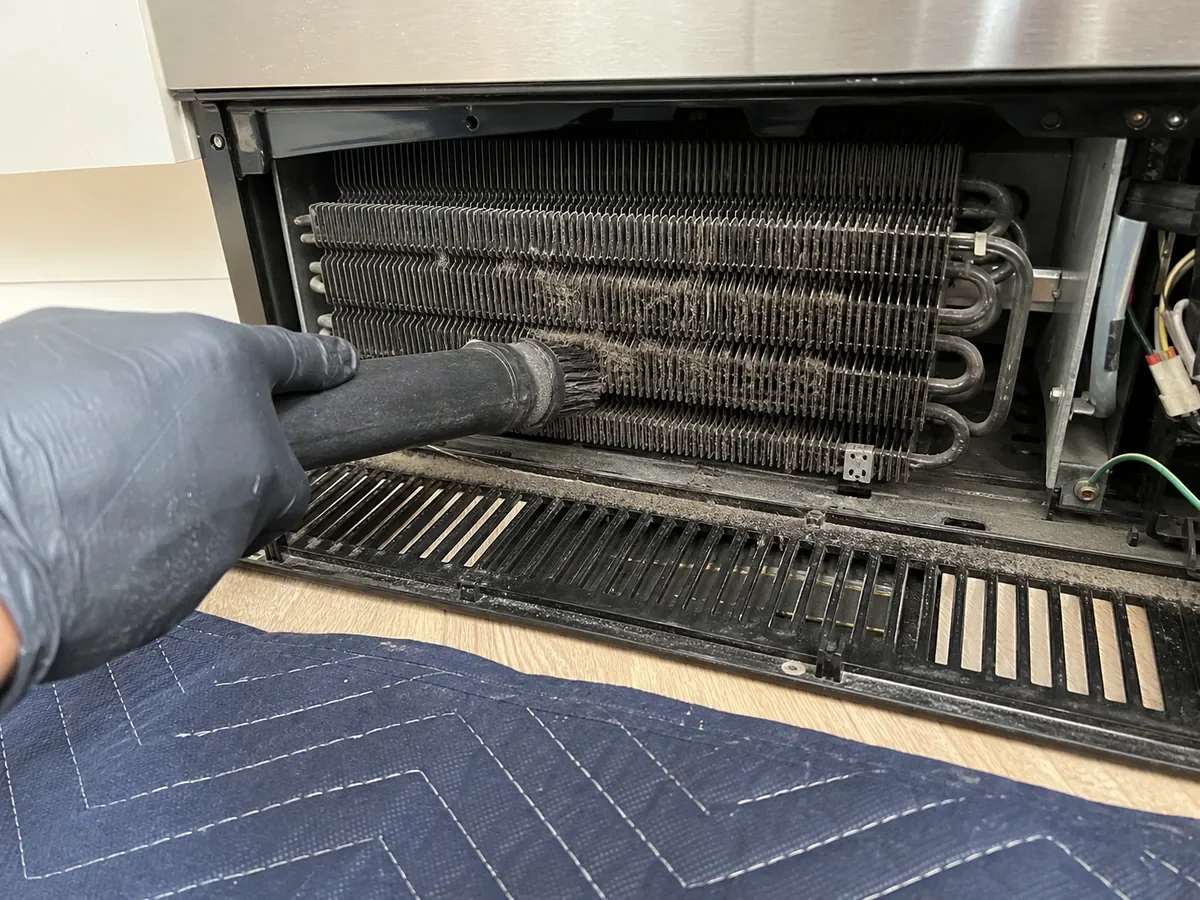
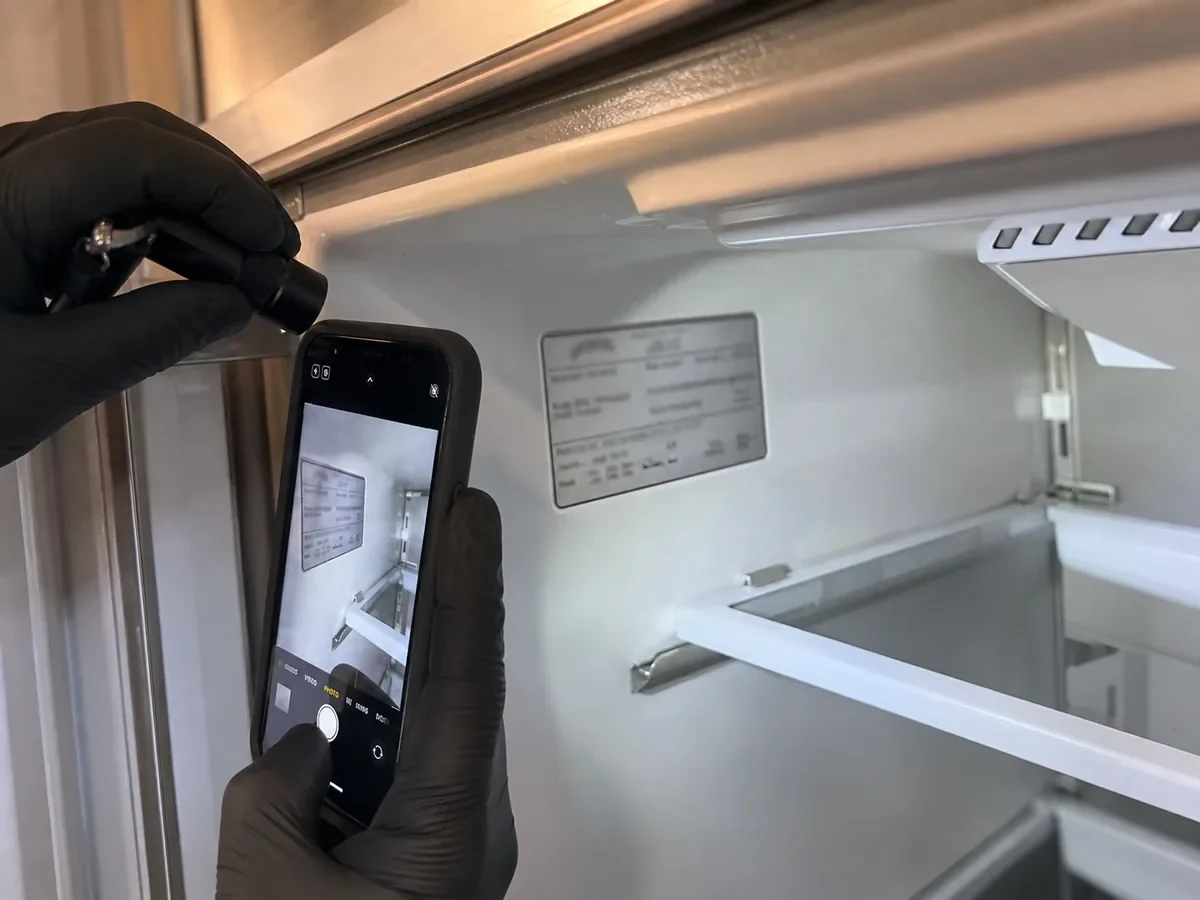
We are a Sub-Zero-focused service. On every call we confirm the model and serial, take temperature readings, photograph the condenser and evaporator, and give a written quote before any work. This guide walks you through the symptoms first so you can decide before you pick up the phone.
Flat $99 diagnostic, credited toward an approved repair.

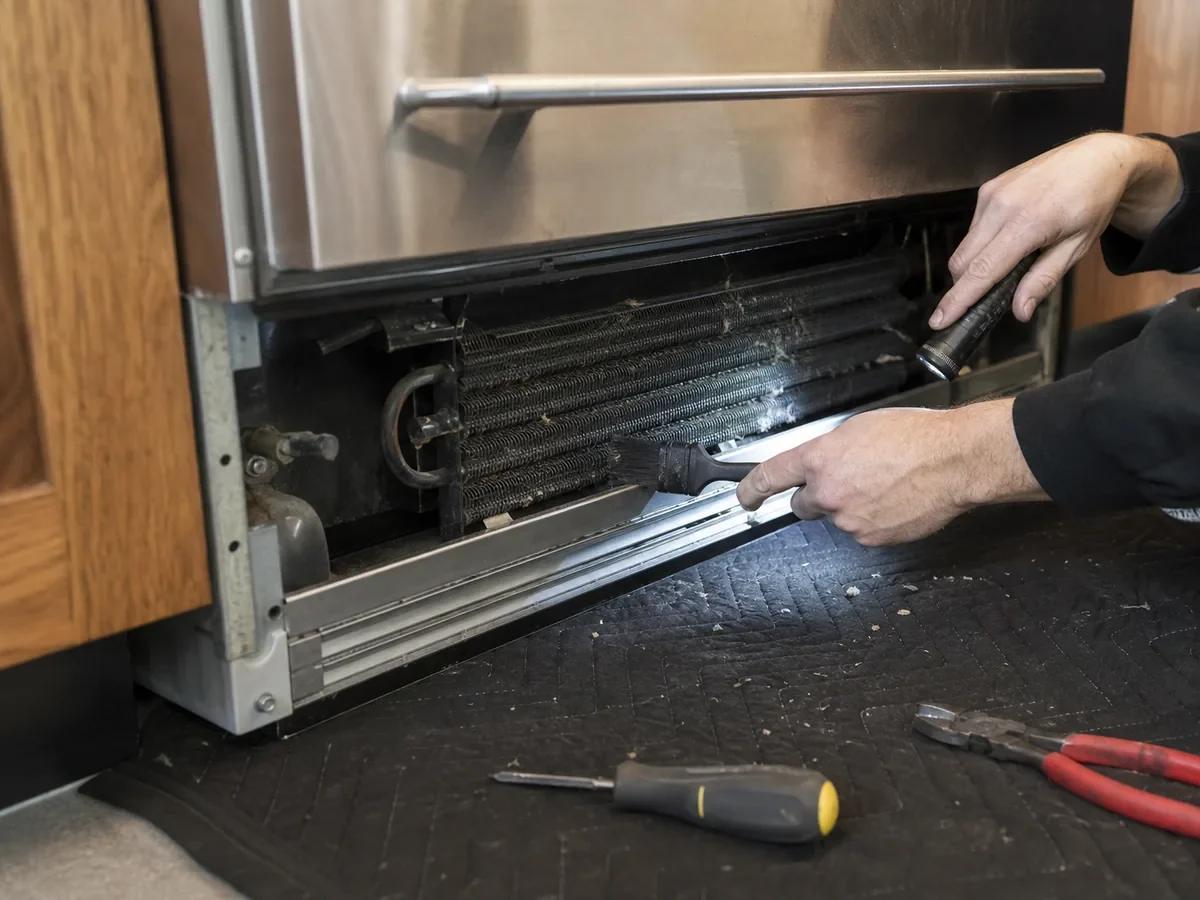
Work-process photo: lower access open, tools and floor protection visible.
Direct answer
Los Altos Hills homeowners reach a Sub-Zero-focused technician for built-in refrigerators, freezer drawers and wine columns. A flat $99 diagnostic visit is credited toward any approved repair. Most repairs run $300–$850; sealed-system or compressor work on a column can reach $1,400–$2,900. Parts are genuine OEM, matched to your model and serial, with a written quote before work begins. Exact pricing is confirmed on site after diagnosis.
- Typical Sub-Zero repair in Los Altos Hills: $99 diagnostic (credited), $300–$850 for most fan, gasket, sensor, ice or control repairs, and $1,400–$2,900 for confirmed sealed-system or compressor work.
- A healthy Sub-Zero holds about 37–38 °F fresh-food and 0 °F freezer; a fresh-food side above ~45 °F with a cold freezer usually means an evaporator fan, sensor or frosted coil — not the compressor.
- Oak pollen and dust along the foothills pack condenser coils fastest in the valley; clearing them twice a year ($230–$460) prevents most warm-cabinet calls.
Direct answers for Los Altos Hills Sub-Zero owners
Short answers that can be cited without guessing
Who repairs Sub-Zero refrigerators in Los Altos Hills?
Meridian Care of Los Altos Hills is a Los Altos Hills Sub-Zero repair resource focused on built-in refrigeration diagnostics, with an emphasis on model verification, cabinet-safe access and symptom-specific repair planning.
How much does Sub-Zero repair cost in Los Altos Hills?
The published planning ranges are $99 for a diagnostic visit credited toward approved repair, $300-$850 for many fan, gasket, sensor, ice maker, water-line or control repairs, and $1,400-$2,900 for confirmed sealed-system or compressor work. The exact quote follows on-site diagnosis, and compressor replacement should not be quoted before evidence.
What should I check before contacting service?
Have the model and serial number, fresh-food temperature, freezer temperature, alarm details if present, cabinet access notes and the symptom pattern ready. These facts let the technician separate airflow, gasket, water, control and sealed-system possibilities. They also help plan cabinet-safe access before the visit.
Can a built-in Sub-Zero be serviced without damaging cabinetry?
Cabinet-safe service starts with trim clearance, floor protection, water and electrical slack, and whether the fault can be diagnosed without pulling the unit. If a pull is required, the reveal, grille and panel alignment should be photographed first. A careful reseat matters as much as the part repair.
Do you charge a separate trip fee for gated estates in 94022 or 94024?
No. The flat $99 diagnostic covers the visit across Los Altos Hills, including gated drives and long foothill driveways in 94022 and 94024, and it is credited toward any approved repair. We confirm an arrival window in advance so a gate or caretaker schedule does not cost you the appointment.
What Sub-Zero models do you see most in Los Altos Hills homes?
Mostly built-in BI-36, BI-42 and BI-48 units, 648PRO side-by-sides, Designer integrated columns, 424/427/430 wine units and UC undercounters. Estate kitchens here often run several at once, so we match each repair to that unit’s own model and serial revision rather than treating them as one system.

Symptom router · Start here · 02
Pick the symptom that matches what your unit is doing
Each tile tells you what it usually means, what not to do while you wait, and where to read the full diagnostic. These six cover the failures we see most often on Sub-Zero built-ins in the foothills.
On dual-refrigeration units this points to the fresh-food evaporator fan, a sensor or a frost-blocked coil — rarely the compressor.
Don’t: keep opening the door to “check” — it loads the warm side further
Not-cooling guide Ice maker slow, jammed or hollow cubesUsually the fill tube, inlet valve, water filter or module — a very fixable failure on built-ins.
Don’t: force the ejector arm or pour hot water into the mold
Ice & water line Wine column drifting off its set pointA few degrees of drift is a thermistor, evaporator fan or control reading the cabinet wrong — collectors notice it before the wine does.
Don’t: assume the wine is ruined and unplug it
Wine storage drift Frost line, condensation or a sweating doorWarm humid room air is leaking past a hardened or torn gasket, or the door is out of alignment behind its panel.
Don’t: scrape frost with metal or run a hair dryer near electronics
Gaskets & seals Display alarm, error code or flashing tempsCodes point at a component but rarely confirm it — they must be read against the model and serial, not a universal chart.
Don’t: trust a generic online code list for your exact unit
Error codes & alarms Both sides warm, compressor loud or always runningThis is the one symptom that can mean a sealed-system or compressor issue — and the one that needs qualified sealed-system verification before any quote.
Don’t: let it run for days hoping it recovers
Sealed system & compressorWhy a cold-side specialist · 03
What “warm fresh-food side, cold freezer” actually tells us
Most Sub-Zero built-ins use dual refrigeration — two separate sealed systems so the fresh-food and freezer compartments hold their own humidity and temperature. When the freezer is still rock-solid but the fresh-food section is creeping up to the high 40s, that split is doing its job and pointing us straight at the fresh-food side: a stalled evaporator fan, a frosted-over coil behind the rear panel, a failed defrost component, or a thermistor feeding the control a bad number. A generalist who treats the whole box as one system often condemns the compressor here; on a Sub-Zero that is usually wrong, and expensive.
A slow ice maker or hollow cubes is a different story with an honest limit: thin or partial cubes usually mean low water flow — a kinked or frozen fill tube, a tired inlet valve, or a filter that is months overdue — but a module or thermistor can mimic the same symptom. We can rank the likely cause from your description, yet we can’t confirm which one it is until we measure fill volume and check the valve on site. We tell you that up front rather than pre-selling a part.
Diagnostic path · Our sequence · 04
How a visit actually runs — booking details to verification
Booking details by symptom
You describe what the unit is doing and when it started. We ask for the model and serial so the right parts and tools are on the truck.
Confirm model & serial
We read the tag in person — Classic, Designer, PRO, undercounter and wine units behave differently, and the serial dates the sealed system and board revisions.
First measurement
Temperature readings in both compartments, airflow at the evaporator, and a look at the condenser before any part is touched.
Isolate the likely part
Fan, sensor, defrost component, gasket, inlet valve, control board or sealed system — narrowed by test, not by guess.
Written quote
Parts and labor in writing before work begins. The $99 diagnostic is credited toward the repair you approve.
Repair with OEM parts
Genuine parts matched to your serial, installed to factory spec, with the cabinetry protected during any pull.
Verify the fix
We re-measure temperatures, watch a full cycle where time allows, and photograph the result so you can see the unit holding.
For sealed systems, control boards and any gas-valve or refrigerant work, we verify before we quote. These are the failures where a wrong guess costs the most, so we confirm with gauges, meter readings and a model-specific check — or we tell you it needs a specialist step — rather than swapping parts and hoping.
What we check · Evidence · 05
The proof a real diagnosis leaves behind
A Sub-Zero call should produce evidence, not adjectives. Here is the kind of reading and photo we capture so the diagnosis is something you can see.
| Symptom | What we measure | Proof we capture |
|---|---|---|
| Fresh-food side warm | Compartment temps, evaporator-fan airflow, coil frost pattern | Thermometer reading + photo of the iced or clear evaporator |
| Slow / hollow ice | Water fill volume, inlet-valve operation, filter age | Fill-tube and valve photo, before/after cube |
| Wine column drift | Set point vs actual, thermistor resistance, fan operation | Display reading + logged temperature over a cycle |
| Frost line at the door | Gasket seal, door alignment, hinge wear | Close-up of the gasket gap and condensation track |
| Both sides warm | Compressor draw, sealed-system pressures (EPA Section 608 compliant) | Meter reading + condenser and compressor photo |


Parts & documentation · 06
Genuine parts, and a record of what changed
When a wine column drifts several degrees, the fix is rarely dramatic — but proving it is the point. We log the set point against the actual cabinet temperature, photograph the condenser and evaporator, capture the model-tag for the exact part, and keep the OEM fan, gasket or control-board packaging as evidence of what went in. You get temperature readings before and after, not a promise.
Parts are genuine OEM, matched to your model and serial — the difference between a fan that holds a collector’s 55°F and a near-miss substitute that drifts again next summer. The invoice names the part and the labor, and a workmanship warranty covers the repair. We don’t use “best parts” language because the serial number, not an adjective, decides the part.
Cold-side specialists
We focus on Sub-Zero built-in refrigeration — dual-refrigeration fresh-food and freezer faults, columns and wine units — rather than every brand. Depth on the cold side is the point.
Model families we service
Classic / BI built-ins, Designer integrated columns, PRO 48, undercounter UC drawers and refrigerators, and 424/427/430 wine units. We keep current on built-in and integrated revisions.
What we document
Model & serial, before/after temperatures, condenser and evaporator photos, the part fitted, and a written quote and invoice. Sealed-system work follows EPA Section 608 rules.
Neighborhoods · Service notes · 07
How the foothills change the service call
Los Altos Hills is not one kind of house. Where you are changes access, the age of the install and the load on the equipment — so it changes the repair.
Fremont Hills
Long private drives and gated entries behind ambitious remodels. Kitchens here favor panel-ready columns and full built-in suites, so the diagnosis has to respect new millwork — we plan the pull before we touch the unit.
Country Club
Established estates near the golf-course stretch, where the Sub-Zero may be a Classic that has run fifteen-plus years. Older built-ins reward parts that are still genuine but no longer obvious — model-and-serial matching matters most here.
Hidden Villa area
Quieter rural parcels out toward Hidden Villa, where a service call is a visit to someone’s home and scheduling windows are real. We confirm access and a precise arrival so a half-day isn’t lost to a gate.
Page Mill corridor
Foothill homes along the Page Mill climb sit under oaks. Pollen and fine dust pack condensers faster here than almost anywhere in the valley — the single most common avoidable Sub-Zero failure on this route.
Altamont
Ridge homes off Altamont Road with steep drives and, often, a wine column or cellar. Temperature stability is the whole point for these owners, so drift complaints get logged over a full cycle before parts are named.
Near Foothill College
The 94022 and 94024 pockets nearer Foothill College mix mid-century remodels with newer integrated kitchens — a good reminder that the model tag, not the address, tells us what we’re working on.
Fremont Hills
Gated drives, new remodels — cabinetry-first diagnosis.
Country Club
Older Classic built-ins — serial-matched genuine parts.
Page Mill corridor
Oak pollen + dust — condensers load fast.
Altamont ridge
Wine columns — drift logged over a full cycle.
Local climate risk · 08
Why these specific kitchens stress Sub-Zero equipment
The pattern in Los Altos Hills isn’t weather, it’s the kitchens themselves. Integrated cabinetry hides the appliance, so early warning signs — a faint frost line, a fan that hums louder, a condenser you can’t see — go unnoticed until the food is warm. High-use built-ins in homes built for entertaining cycle harder than a standard fridge. Panel-ready columns conceal the very grille that needs cleaning, and the large remodel budgets here make “just replace it” a tempting, costly default when a fan or sensor would do.
The fix is boring and effective: with the Page Mill foothills throwing oak pollen and dust at exposed coils, the condenser should be cleared roughly twice a year, and a drifting wine column should be logged before it’s opened up. That single maintenance habit prevents more “fresh-food side warm” and “column drifting” calls than any part we carry. Precise scheduling matters too — these are working households, and a confirmed window is part of the repair.
Service area centered on Los Altos Hills (94022, 94024) — the highlighted boundary marks the city we cover, with adjoining Los Altos, Palo Alto and Cupertino.
Pricing
Sub-Zero repair pricing in Los Altos Hills
| Service / symptom | What's included | Price range | Time |
|---|---|---|---|
| Diagnostic visit | Model/serial ID, temperature + airflow readings, written findings | $99 (credited to repair) | 45–90 min |
| Condenser deep-clean & airflow service | Pull-free coil clean, fan check, oak-pollen/dust removal | $230–$460 | 1–2 hrs |
| Door gasket / seal replacement | Serial-matched gasket, seat and leak test | $300–$640 | 1–3 hrs |
| Ice maker module / fill tube / inlet valve | Fill-volume test, valve or module, line clear | $300–$720 | 1–3 hrs |
| Evaporator fan motor | Serial-matched fan motor, airflow verification | $360–$740 | 1–3 hrs |
| Thermistor / temperature sensor | Resistance test, serial-matched sensor, recalibration | $280–$560 | 1–2 hrs |
| Control board (serial-matched) | Output test, serial-matched board, verification | $520–$850 | 1–4 hrs |
| Refrigerant leak + recharge (EPA 608) | Leak isolation, repair, evacuate and weighed charge | $1,400–$2,100 | 3–6 hrs |
| Compressor replacement | Sealed-system pull, compressor, filter-drier, recharge | $1,900–$2,900 | 4–8 hrs + parts |
What sets the final number: the exact model and serial revision, whether the unit must be pulled from its custom cabinet, and parts availability — all confirmed on site after the $99 diagnostic.
After the diagnosis, not before
Check whether repair makes sense before replacing
Call now or book diagnostic online with your Sub-Zero model number and what the unit is doing. We’ll tell you the likely path and the honest range — repair or, when it’s the right call, replacement.
Questions · 09
Sub-Zero questions we actually get in Los Altos Hills
My Sub-Zero freezer is cold but the fridge side is warm — is that the compressor?
Usually not. On dual-refrigeration Sub-Zeros the two sides run separately, so a warm fresh-food side with a working freezer points to the fresh-food evaporator fan, a frosted coil, a defrost component or a sensor — all far less costly than a compressor. We confirm with temperature and airflow readings before naming a part.
How much does Sub-Zero repair usually cost in Los Altos Hills?
A flat $99 diagnostic is credited toward any approved repair. Most repairs land between $300 and $850; sealed-system or compressor work on a column can reach $1,400–$2,900. You get the exact figure in writing after the on-site diagnosis — no part is ordered before you approve it.
Do you use genuine Sub-Zero parts?
Yes — genuine OEM parts matched to your model and serial. On built-ins the difference is real: a serial-matched evaporator fan or control board behaves to spec, where a near-equivalent can drift or fail early. The invoice names the exact part fitted.
Can you pull a built-in without damaging my cabinetry?
That’s the core skill on these homes. We plan the pull before touching the unit, protect the surrounding millwork, and reseat panel-ready fronts to alignment. Cabinet-safe handling is why we ask for the model up front.
Is it worth repairing a 15-year-old Sub-Zero?
Often yes — Classic built-ins are engineered for 20-plus years, and a fan, gasket or board repair on a sound sealed system is a fraction of replacement plus cabinetry rework. When it isn’t worth it, we say so; see our repair-vs-replace framework for how we score it.
Keep reading
Where to go next
Local review signal
Google review highlights for Sub-Zero service in Los Altos Hills
Owners usually care about the same three things: careful diagnosis, protected cabinetry and a quote that follows evidence.
The $99 diagnostic was credited toward a $300 door-gasket repair on our 648PRO. Genuine serial-matched parts, a written quote before any work, and the gated driveway handled without fuss.
Homeowner, Fremont HillsOur 424 wine column drifted to 59 °F set at 55. They logged set point against a probe over a full cycle, then recalibrated and replaced the thermistor for $340. Careful around the panels, clear readings.
Wine collector, Altamont ridge