
Climate care field guide · Freezer not freezing
Your Sub-Zero freezer won't hold — but the fridge is fine? Read the split first
The tell is in the freezer, not the fridge: ice cream gone to soup, a bag of peas you can squeeze, the bright crust of frost on the walls suddenly gone, or the ice maker quietly quitting. And often the strange part — the fresh-food side above is still perfectly cold. On a Sub-Zero, that split is not a contradiction. It is the most valuable clue you can hand us.
Built-in Sub-Zeros are dual-refrigeration machines: the freezer and the fresh-food compartment are cooled by separate sealed systems, each with its own evaporator. So a warm freezer over a cold fridge tells us the failure lives on the freezer's own circuit — its evaporator fan, its defrost, its sensor — and almost never the whole machine. That narrows the repair, and the bill, before we drive out.
Why is my Sub-Zero freezer not freezing while the fridge stays cold?
Los Altos Hills Sub-Zero Repair traces a warm Sub-Zero freezer with a cold fresh-food side to the freezer evaporator fan, an iced-over evaporator from a defrost fault, or a sensor reading wrong — because dual-refrigeration units cool each compartment separately, a cold fridge proves the rest of the machine is healthy. Call (650) 668-1043.
Flat $99 diagnostic, credited toward an approved repair.
Direct answer
When a Sub-Zero freezer stops freezing but the fresh-food side stays cold, the cause is on the freezer's own circuit: most often a stalled evaporator fan, an evaporator iced over from a defrost fault, or a sensor feeding the board a wrong number. Because dual-refrigeration units run the two compartments separately, a cold fridge proves the compressor and controls are largely healthy — the fix is usually a $300–$760 part, not a sealed-system job. A flat $99 diagnostic confirms which, credited toward the repair. We measure before we name a part.
- On dual-refrigeration Sub-Zero columns, a warm freezer with a cold fresh-food side is the freezer evaporator, defrost or fan — typically $300–$760, not the compressor.
- Secondary freezers in Los Altos Hills — garage, butler's pantry, pool-house and basement-cellar units — carry a heavier summer load on the inland foothill side, where afternoons run hotter than the coast.
- If both compartments are warming together, that is a different problem — start with the not-cooling diagnostic, where a packed condenser is the usual cause.
Read the split · 01
Warm freezer, cold fridge: what dual refrigeration is telling you
Most built-in Sub-Zeros — the 600-series side-by-sides, the 700-series over-and-unders, the integrated columns — use two independent sealed systems so the freezer can stay bone-dry at 0 °F while the fresh-food side holds a humid 38 °F. The practical upshot for a diagnosis is simple: each compartment can fail on its own. When the freezer drifts up while the fridge holds, the freezer's evaporator section is the place to look, and the still-cold fridge is positive proof that the compressor on the other circuit, the main control, and the house power are all doing their jobs.
The usual suspects, in order: the freezer evaporator fan has stalled, so the compartment makes cold at the coil but never circulates it; the evaporator has iced into a solid block because a defrost heater, limit or control quit, choking its own airflow; or a thermistor is telling the board the freezer is colder than it is, so the system under-cools. Each leaves a different fingerprint — no airflow at the vent, a wall of frost behind the rear panel, or a display number that doesn't match a real thermometer — and each is a bounded repair on a sound machine.
The secondary freezer · 02
Garage, pantry and pool-house freezers carry a foothill-summer load
Los Altos Hills kitchens rarely stop at one cold box. The homes we serve commonly run a second or third freezer — a column in the butler's pantry, a drawer unit in the island, a stand-alone in the garage or the pool house, sometimes a freezer paired with the wine room downstairs. The ones outside the conditioned core are the ones that call us in July, because Los Altos Hills sits on the warm inland side of the ridge, away from the marine fog, and a garage on a south-facing hillside lot can run 90-plus degrees while the unit inside is asked to hold zero.
That heat load is mechanical, not cosmetic. A freezer rejecting heat into 95-degree air runs longer and hotter, and any weak link — a tiring fan bearing, a marginal defrost, a condenser already loaded with dust — gives out first under that strain. It ties directly to our summer-heat guide: the single best thing an owner can do for a secondary freezer is keep its condenser clear and its surrounding air as cool as the space allows, especially before the first real heat.
Drawers, gaskets and the slow thaw · 03
Why freezer drawers and gaskets fail differently
Built-in freezer drawers and the lower drawers on French-door columns have their own failure mode. They are opened by hand dozens of times a day, the gasket runs around a sliding drawer rather than a hinged door, and a bag of food wedged at the back will hold the drawer open a few millimeters all night. That hairline gap lets humid kitchen air in, which frosts the gasket, which holds the drawer open a little wider — a slow spiral that ends with a freezer that can't get back to zero and a frost ridge along the seal.
So before we condemn anything electrical on a drawer unit, we check the obvious mechanical causes: a packed drawer, a gasket gone hard, a drawer out of alignment, a runner full of ice. These overlap with the symptoms on our door gasket and seal page. When the freezer is genuinely losing its hold and the seal checks out, then it's the evaporator, defrost or sensor — and that's where the meter comes out.
| Likely cause | What you would notice | How we test it | Typical repair |
|---|---|---|---|
| Freezer evaporator fan stalled | Freezer warming, fridge fine, no air felt at the freezer vent | Listen and feel for airflow, meter the fan motor and its circuit | Replace evaporator fan; $340–$680 |
| Evaporator iced over (defrost fault) | Slow thaw, a wall of frost behind the rear freezer panel | Inspect the coil for ice; test defrost heater, limit and control | Replace defrost part + clear ice; $360–$760 |
| Thermistor reading the freezer wrong | Display says cold; a real thermometer says warm | Read thermistor resistance against the chart, compare to a probe | Replace sensor; $280–$540 |
| Drawer gasket / alignment leak | Frost ridge on the seal, drawer not pulling fully shut | Seal test and drawer-alignment check over a cycle | Reseat or replace gasket; $300–$620 |
| Heat-stressed condenser (secondary unit) | Garage or pantry freezer struggling only in summer heat | Read condenser load and compartment temps, clean and re-measure | Condenser clean + airflow; $230–$460 |
| Sealed-system / compressor fault | Freezer never recovers after fan, defrost and airflow check out | Gauge readings under EPA Section 608 rules by a qualified tech | Sealed-system work; $1,400–$2,900 |
Step by step
Diagnose a Sub-Zero freezer that is not freezing
Confirm the split
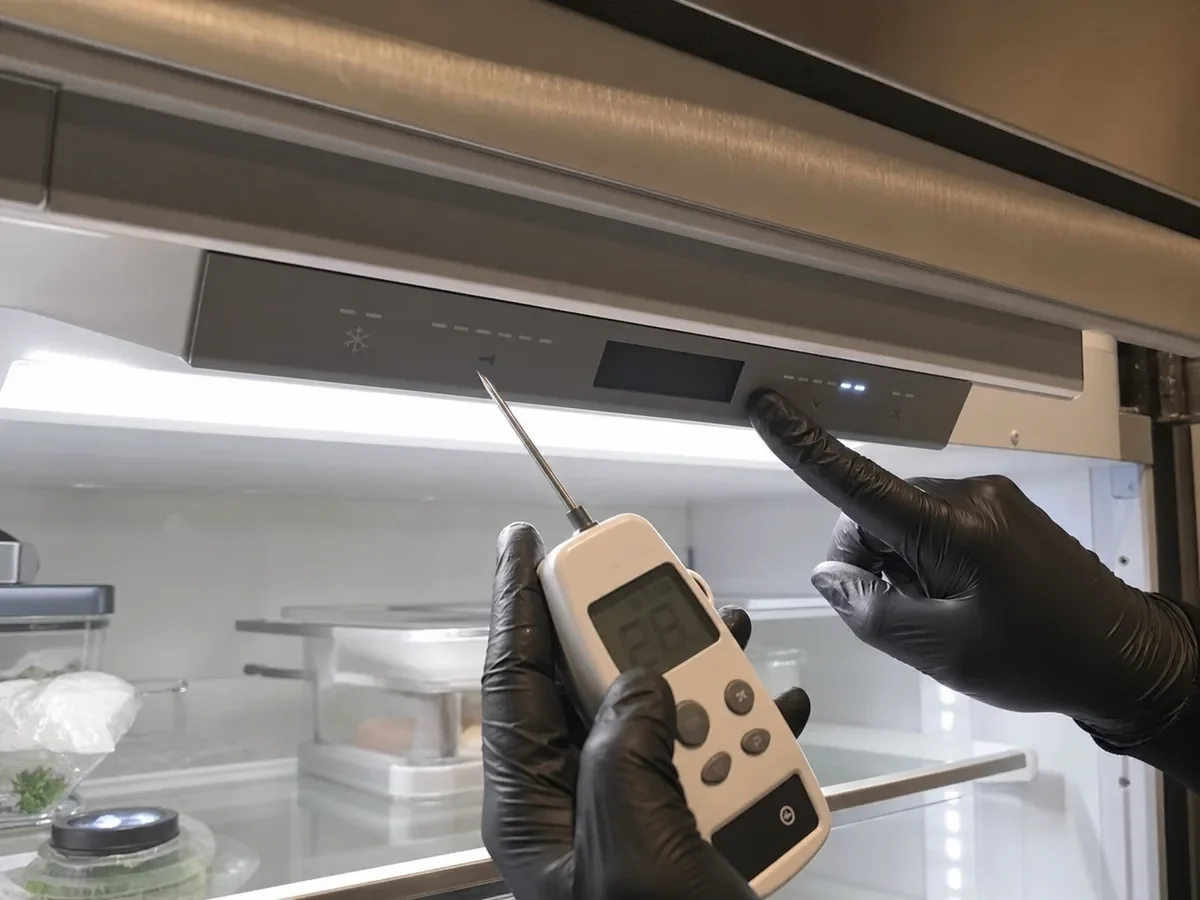
Check both compartments with a real thermometer. A warm freezer with a fresh-food side still near 38 °F points to the freezer circuit, not the compressor.
Feel for freezer airflow
Hold a hand at the freezer vent. No moving air usually means a stalled evaporator fan or an evaporator iced solid behind the panel.
Check the door or drawer
Make sure nothing is holding the drawer or door open and look for a frost ridge on the gasket — a slow leak there can warm a freezer on its own.
Read the model and serial
Photograph the tag inside the door frame so the correct fan, defrost part or sensor for your revision is matched before the visit.
Measure, then repair
On site we meter the fan, test defrost and read the sensor before naming a part; sealed-system pressures are checked only if the simpler causes pass. The $99 diagnostic is credited.
This page is about a warm freezer with a cold fresh-food side. If both compartments are drifting up together, the problem is shared — usually a condenser packed with oak pollen and dust, or the main control — and you should start with the not-cooling diagnostic instead. A genuine sealed-system or compressor fault is the least common cause and the only one needing gauge work under EPA Section 608 rules, which we verify on site rather than guess.
After you've matched the symptom, not before
Call or book online
Call or book online with both compartment temperatures from a real thermometer and the model and serial from the tag. The freezer-warm-fridge-cold split tells us to bring the right evaporator fan, defrost part or sensor, so the repair often happens on the first visit.
FAQ
Freezer questions we get in Los Altos Hills
My Sub-Zero freezer is warm but the fridge is still cold — is the compressor dead?
Almost certainly not. Built-in Sub-Zeros are dual-refrigeration, so the freezer and fridge run on separate sealed systems. A cold fresh-food side proves that circuit, the main control and the power are fine, and points the fault at the freezer’s own evaporator fan, defrost or sensor — all far cheaper than a compressor.
How cold should a Sub-Zero freezer actually be?
About 0 °F for proper freezing, with the fresh-food side near 37–38 °F. If a real thermometer in the freezer reads in the teens or twenties while the fridge holds, the freezer circuit is under-cooling — usually a stalled evaporator fan or an iced evaporator — and it is worth a diagnostic before food is lost.
Why does my garage or pantry freezer only struggle in summer?
Los Altos Hills sits inland of the coastal fog, so an uninsulated garage or pantry on a hillside lot can hit the 90s on a summer afternoon. A freezer rejecting heat into that air runs at the edge of its envelope, and a marginal fan, defrost or a dust-loaded condenser fails under the strain. Keeping the condenser clear before the heat arrives prevents most of these calls.
There is a thick wall of frost in my freezer — is that the problem?
Often yes. A solid sheet of frost on the rear freezer panel usually means a defrost component has quit, so the evaporator ices up and chokes its own airflow until the compartment warms. Do not chip it with metal or aim a hair dryer at the electronics — we test the defrost heater, limit and control and clear the coil safely.
Is a freezer repair worth it on an older built-in?
Usually, yes. A Sub-Zero column is engineered for twenty-plus years, and an evaporator fan, defrost part or sensor on a sound sealed system is a fraction of replacement plus the cabinetry rework a swap forces in a panel-ready kitchen. If the sealed system itself has failed on a tired unit, we will show you the readings and say so.
Keep reading