
★★★★★
Reading the tag in person on our BI-36 mattered — they brought the revision-specific evaporator fan and finished in one visit. No reorder delay because they didn't guess the part from the model alone.
Russell C., Homeowner, Matadero HillsClimate care field guide · Los Altos Hills
When a Sub-Zero in your Los Altos Hills kitchen starts misbehaving — the fresh-food section warm while the freezer still holds, say, in one of the panel-ready built-ins common around Fremont Hills — the first thing we ask for is not the symptom. It's the model and serial. That tag tells us which evaporator fan, control board or gasket your exact unit takes, and the serial dates the sealed-system and board revisions that change the fix.
This guide shows you where the tag hides by family, how to read the number, and what photo to have ready so the right part is on the truck.
No part is ordered before you approve a written quote.
Locate it fast
Open the door and check the first column; if the plate is faded or blocked behind millwork, the backup spot usually holds the same number. This is the order we use on Los Altos Hills built-ins around Fremont Hills and the Matadero Hills estates.
| Unit type | First place to look | Backup location |
|---|---|---|
| Built-in / column (BI, IC, IT) | Upper interior side wall of the fresh-food compartment | Framework behind the lower (toe-kick) grille |
| Undercounter drawer (UC) | Inner side wall of the cabinet beside the drawer | Inside the door / drawer frame |
| Wine column (424 / 427 / 430) | Inner door frame near the hinge | Lower interior wall, often below the bottom rack |
| Classic / freestanding & PRO | Upper-left interior wall near the top hinge | Behind the lower grille or in the door frame |
Photograph the model and serial in one shot — the serial is what dates the board and sealed-system revision your part must match.
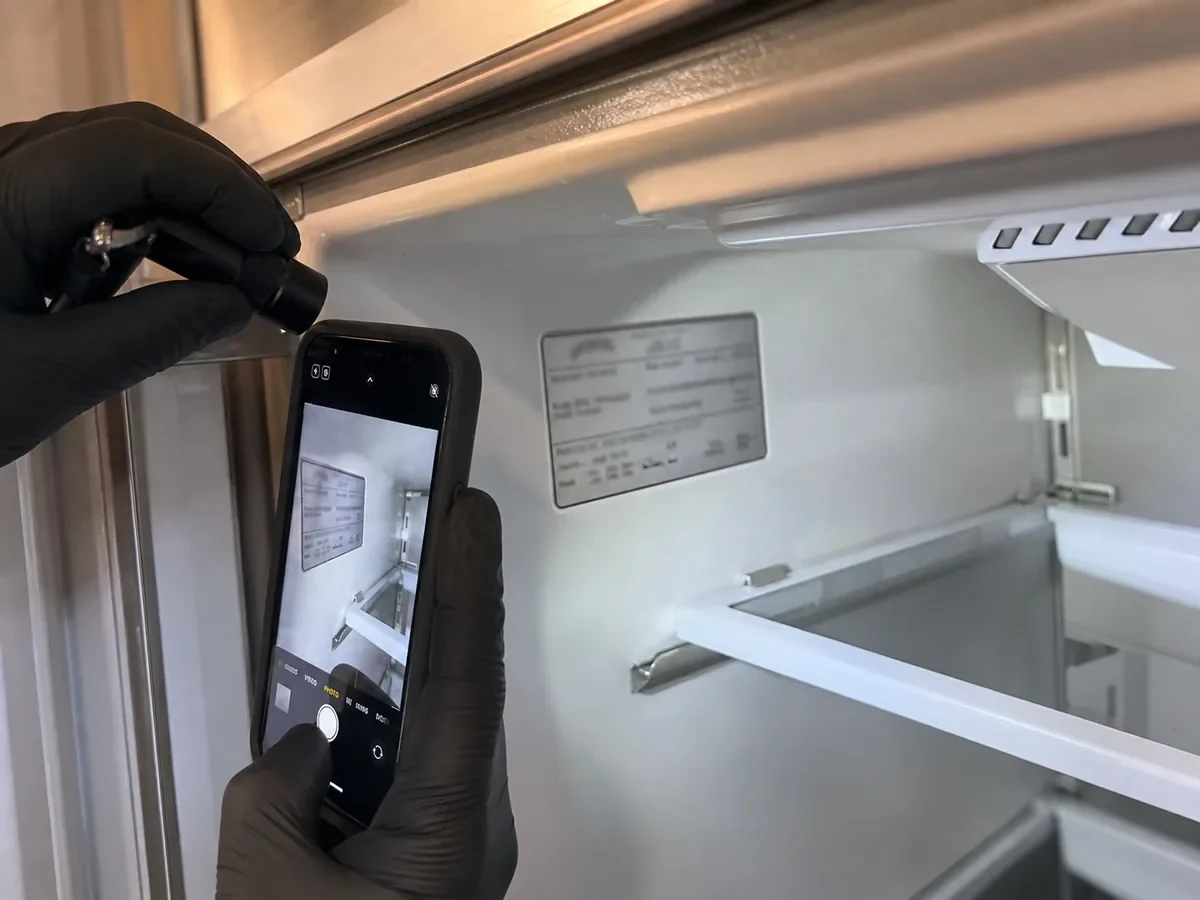
On Los Altos Hills built-ins the Sub-Zero model and serial tag sits on the upper interior side wall of the fresh-food compartment; on IC/IT columns and UC drawers it's on the inner side wall; behind the lower grille on some built-ins; on 424-series wine cabinets in the inner door frame. Photograph the model and serial in one shot.
Where the tag lives · Locate it · 01
Sub-Zero doesn't put the plate in one universal spot — it moves by appliance family. Open the fresh-food door and look in this order. The schematic at left is the kind of model-specific parts drawing we work from once we have your number; it keeps the fan, gasket or board matched to your serial rather than substituted.
Most owners find the tag in under a minute once they know the family. If you can't read it cleanly, don't strain to pull the unit out — a phone photo of the plate is all we need, and forcing a panel-ready built-in forward risks the very cabinetry the install was built to protect.
Evidence vs service · The split · 02
The left side is the evidence you can read off the plate yourself. The right side is what that evidence changes about the repair — why we ask for it before we name a part.
The model number names the family and configuration: BI-36UFD is a 36-inch Built-In with an Upper Freezer Drawer; IC-30CI is a 30-inch integrated column with internal ice. The serial number is the time stamp — it tells us which production run your unit came from. Two refrigerators wearing the same model can take a different control board or evaporator fan depending on where the serial falls in the revision history. Photograph both lines, plus any smaller type/spec line beneath them.
Before a Los Altos Hills visit, the serial lets us pull the correct parts diagram, confirm whether a board revision applies to your run, and load the right fan, gasket, thermistor or inlet valve onto the truck. On dual-refrigeration Sub-Zeros that split the fresh-food and freezer into separate sealed systems, the serial also tells us which compartment's components were revised — so a 'warm fresh-food side' call doesn't turn into a guess. The number is how we avoid a second trip.
Why it matters · 03
On a mass-market refrigerator you can often get away with a universal part. On a Sub-Zero you usually can't, and the serial is the reason. Sub-Zero boards the sealed-system and control revisions to the serial range: the same BI-36 built across a decade went through quiet changes to its control board, evaporator fan motor, defrost components and even gasket profile. A part that fits an early serial can be wrong for a later one of the identical model. Order by symptom alone and you risk a fan that spins but reads the cabinet wrong, or a board that flashes the same error it was meant to clear.
This is sharpest on dual-refrigeration units. Because the fresh-food and freezer run as two independent systems, a warm fresh-food side with a still-frozen freezer points at one specific evaporator and its fan, sensor and defrost set — and which revision of that set you have is a serial question. We match the number to the diagram first, then diagnose, rather than carrying a 'close enough' part and hoping.
Read the number · 04
The prefix tells you the family; the digits tell you the width and configuration. Here's how the common families decode.
The flush built-in refrigerators and freezers that sit behind cabinet panels. Digits give the width and the suffix the layout — BI-36UFD is 36" with an upper freezer drawer, BI-48SD is a 48" side-by-side. These run dual refrigeration, so a warm fresh-food side is its own diagnosis.
Fully integrated columns made to disappear into millwork. IC- denotes a refrigerator or freezer column; IT- appears on integrated tall/transitional column ranges. Common around newer Fremont Hills remodels, where the appliance is invisible until the tag is found.
The PRO 48 and related professional built-ins — stainless, high-capacity, often paired with a pro range. Their service access and component layout differ from Classic BI units, so the model line matters before the truck is loaded.
Undercounter refrigerators, freezer drawers and beverage units tucked into islands, butler's pantries and bars. UC-24 families share a footprint but vary in compressor and drawer hardware by serial.
Built-in and integrated wine cabinets, often dual-zone. These are the units a collector watches closely — a wine column drifting several degrees is usually a thermistor, fan or control reading, and the exact part is serial-specific.
A second common reason owners go hunting for the tag is the ice maker: slow production, jammed cubes, or hollow, half-formed cubes. The way you notice it is gradual — the bin takes a day to refill instead of hours, or the cubes come out thin-walled and crack when you grab them. With the model number we can pull the right ice module, fill tube, inlet valve and water-filter spec for your exact built-in, so we arrive carrying parts that actually fit rather than a generic kit.
What the tag can't do is tell us whether the cause is low water flow (a kinked or frozen fill tube, a tired inlet valve, an overdue filter) or the module and thermistor mimicking the same symptom. Those read identically from the outside. So the model number gets the right parts on the truck; the on-site fill-volume measurement and valve test decide which one we actually install. We tell you that order up front rather than pre-selling a module.
The photo we need · Model tag ? 05
A clear model and serial readout does more work than a long description. Here's exactly what to check so we can quote the path and pack the right part.
Years of cold and condensation can fade a paper plate, and on some integrated columns the tag sits awkwardly behind a door. If you can't read every character, keep what is legible and describe the cabinet family when you call or book online — we can often identify the family from the cabinet, then confirm the serial in person. Don't pull a panel-ready built-in forward to chase the plate; protecting the cabinetry comes first.
On the quieter rural parcels out toward Robleda Heights, where a service call means a drive down a long private lane and a confirmed arrival window matters, we'll read and record the serial on the scheduled visit rather than ask you to wrestle the plate yourself — so a faded tag never costs you a half-day waiting at a gate or a second trip for the wrong part.
Local proof · 06
Out on the established estates near the Matadero Hills golf-course stretch, the Sub-Zero is often a Classic BI built-in that has run fifteen or twenty years behind original millwork. That's exactly where model-and-serial matching earns its keep: parts for a long-running unit are still genuine but no longer obvious, and several revisions may have shipped under the same model badge over its life. Reading the serial off the plate tells us which evaporator fan or control board your specific run takes — the difference between a part that drops in and one that's a near-miss. The age of these installs, not the address, is what makes the tag the first thing we ask for here.
What we document · 07
When a wine column drifts several degrees off its set point, the model tag is where the evidence chain starts. We log the set point against the actual cabinet temperature, photograph the condenser and evaporator, and record the model-tag details so the part we name is the part your serial takes — typically an OEM thermistor, evaporator fan or control board rather than a generic substitute. You see temperature readings before and after and the packaging of the part that went in, not a promise. The serial-matched fan is what holds a collector's 55°F; a close-enough replacement is what drifts again next summer. That same documentation discipline — model/serial record, temperature log, OEM-part evidence — is how we keep a diagnosis honest whether the symptom is drift, a warm side or slow ice.
Step by step
Open the door and look on the upper interior wall, the side of a drawer, or behind the lower grille.
A clear photo lets the correct revision-specific part be matched before the visit.
The serial dates the sealed system, board and fan revisions for the same model.
We match the number to the parts diagram first, then diagnose.
Serial-matched parts mean a precise range — fan $360–$740, board $520–$850 — after the $99 diagnostic.
Pricing
| Service / symptom | What's included | Price range | Time |
|---|---|---|---|
| Thermistor / temperature sensor | Resistance test, serial-matched sensor, recalibration | $280–$560 | 1–2 hrs |
| Evaporator fan motor | Serial-matched fan motor, airflow verification | $360–$740 | 1–3 hrs |
| Control board (serial-matched) | Output test, serial-matched board, verification | $520–$850 | 1–4 hrs |
| Ice maker module / fill tube / inlet valve | Fill-volume test, valve or module, line clear | $300–$720 | 1–3 hrs |
What sets the final number: the exact model and serial revision, whether the unit must be pulled from its custom cabinet, and parts availability — all confirmed on site after the $99 diagnostic.
After you've found the plate
Call or book online to request the visit. The model and serial plate helps match the right part, and the on-site diagnosis confirms the repair path before any part is ordered.
Questions · 08
On most built-in (BI) units, open the fresh-food door and look at the upper-left interior wall, or check the framework behind the top grille. Integrated IC/IT columns put it on the interior side wall near the top; undercounter UC units carry it in the door frame; 424-series wine cabinets place it on the lower interior wall, often below the bottom rack. Photograph the whole plate so both the model and the serial are readable.
Because Sub-Zero ties its sealed-system and control-board revisions to the serial range. The same model built years apart can take a different control board, evaporator fan or gasket profile. The serial tells us which revision your unit is, so the part we bring fits your specific run instead of being close enough.
Keep a photo of whatever is legible ready plus a wider shot of the whole appliance. We can usually identify the family — built-in, integrated column, undercounter or wine cabinet — from the cabinet and door, then confirm the serial in person. Please don't pull a panel-ready unit forward to reach the plate; that risks the cabinetry, and it isn't necessary.
It tells us which ice module, fill tube, inlet valve and filter your unit takes, so we arrive with parts that fit. It can't tell us whether the cause is low water flow or the module itself — those look identical from outside. We confirm that by measuring fill volume and testing the valve on site before installing anything.
The model and serial number identify the exact fan, gasket, board, valve, thermistor and sealed-system revision used in the unit. Two built-in Sub-Zero refrigerators can look identical from the kitchen and still need different parts. A clear model/serial record lets the quote follow the appliance evidence instead of a catalog guess.
Use the clearest readable model or serial characters you can find without forcing panels or removing trim. Describe the unit family and access path when you call or book online. If the tag is blocked, the technician can locate it on site before ordering parts.
Keep reading
Local review signal
Owners usually care about the same three things: careful diagnosis, protected cabinetry and a quote that follows evidence.
Reading the tag in person on our BI-36 mattered — they brought the revision-specific evaporator fan and finished in one visit. No reorder delay because they didn't guess the part from the model alone.
Russell C., Homeowner, Matadero HillsOur tag had faded almost to nothing, but they decoded it from the serial and the right serial-matched control board came on the first trip. They matched the number to the diagram before diagnosing anything.
Deborah P., Homeowner, WestwindKnowing we actually had a 430 wine unit and not a 424 made the sensor quote exact, and it was done the same day. The detail on the tag is clearly what makes the difference on these.
Martin F., Homeowner, Fremont Hills