Skip to content
Meridian Care of Los Altos Hills logoMeridian CareLos Altos Hills · Sub-Zero
Google rating 4.9 / 5 214 local reviews Sub-Zero-first service for Los Altos Hills

Climate care field guide · Decision

Repair or replace your built-in Sub-Zero — score it before you spend

If a built-in Sub-Zero in your Los Altos Hills kitchen is showing a door gasket leak, condensation or a frost line, the question on most owners' minds isn't "what's wrong" — it's whether this unit is still worth keeping. A failing gasket on a sound twelve-year-old column is a clear repair. The same symptom on a unit already short on parts, paired with a rusting cabinet, can tip the other way. Out toward Hidden Villa, where a single column can be panel-matched into custom millwork, that decision carries real cabinetry cost, so it deserves a scored answer rather than a guess.

Flat $99 diagnostic, credited toward an approved repair.

CONDENSER BAY · TOP GRILLE FRESH-FOOD ZONE FREEZER DRAWER Model / serial tag Panel-ready custom front Schematic — proportions illustrative; confirm by model & serial.
A built-in column at a glance: condenser bay behind the upper grille, sealed system, evaporator and the model/serial tag inside the door frame. Where the failure sits — and how it reaches the cabinetry — is what tips the repair-or-replace score.

Direct answer

For a Sub-Zero built-in in Los Altos Hills, repair is usually the right call when the unit is under fifteen years, the sealed system is intact, and parts for your model and serial are still available. Replacement earns its keep when the sealed system has failed on an aging unit, the cabinet itself is compromised, or genuine parts are no longer made. We don't pretend repair always wins — but we also don't sell a replacement before a flat $99 diagnostic tells us which side of the line your unit is on. The diagnostic is credited toward any approved repair.

Los Altos Hills facts
  • Repair vs replace in Los Altos Hills: most repairs $300–$850 and sealed-system $1,400–$2,900, versus $9,000–$18,000+ to replace a built-in with cabinetry rework.
  • Classic built-ins are engineered for 20+ years; a fan, gasket or board on a sound sealed system is usually worth repairing.
  • Replacement makes sense when a unit has multiple major failures or an unsafe sealed system, especially where the panel and millwork must be refit.

The honest second question · 01

When the symptom hints at the sealed system, the math changes

Most repair-or-replace decisions are simple once you know what failed. The one that isn't is a sealed-system suspicion — both compartments warm, a compressor running constantly, a column that never recovers temperature. That points toward a refrigerant leak, a restriction, or a tired compressor, and it is the single failure that can push an otherwise sound Sub-Zero toward replacement, because sealed-system work is the most expensive repair on the unit.

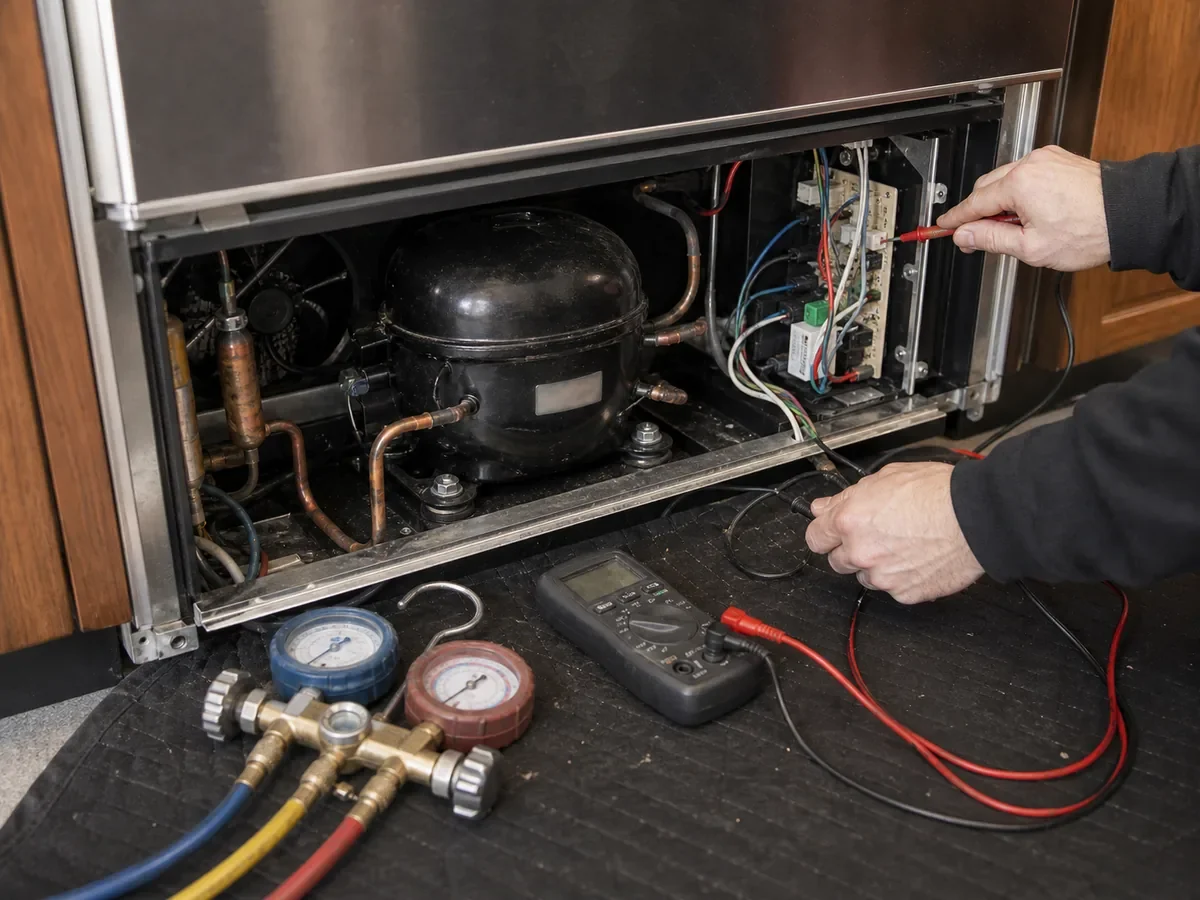
Here's what confirms it, and the honest limit. A sealed-system fault is verified under EPA Section 608 with gauges on the system — measured pressures, superheat and subcooling, a leak trace, compressor amp draw — not read off a symptom or an error code. Until those readings are taken, we cannot tell a $400 control or fan fault from a $2,000 sealed-system repair; the two can look identical from the kitchen. That is precisely why we measure before we ever advise repair or replacement, and why no quote on this category is given over the phone.

Decision matrix · Framework · 02

Six factors, scored toward repair or toward replacement

No single factor decides it. Read across each row, see which column your unit lands in, and the pattern tells you the honest direction. We score the same way on site — with readings, not impressions.

How we weigh a Sub-Zero repair-versus-replace decision. The final call comes after on-site diagnosis — this is the framework, not a quote.
FactorLeans toward repairLeans toward replacement
Unit ageUnder ~15 years; Classic/BI built-ins engineered for 20+ with carePast 20 years with multiple aging systems and a tired compressor
Cabinet / remodel impactCabinetry is sound; a repair pull-and-reseat protects existing millworkCabinet rusting or water-damaged, or a remodel is already planned around it
Part availabilityGenuine OEM fan, gasket, board or valve still made for your model/serialKey parts discontinued; only salvage or non-OEM substitutes remain
SafetyRoutine fan, sensor, gasket, defrost or ice-system workRepeated electrical faults, or a sealed-system fault that recurs after repair
Repair cost vs unit valueRepair is a fraction of replacement plus cabinetry reworkSealed-system or compressor repair on an aging unit nears the cost of new
Replacement disruptionDrop-in repair, kitchen back in service same visit in most casesReplacement needs panel refitting, possible cabinet modification, lead time
Performance after repairOne isolated failure on a unit that otherwise holds temperatureDrift or warming persists across systems even after sound parts go in
Energy and reliabilityEfficient enough; the failure is the exception, not the patternFrequent service visits stacking up; reliability no longer earns the keep
Technician using meter leads near a built-in refrigerator compressor with gauge set and tools visible.
Verified testSealed-system evidence. Compressor and refrigerant work is confirmed with meter/gauge readings under EPA Section 608 handling rules, not quoted from a phone description.
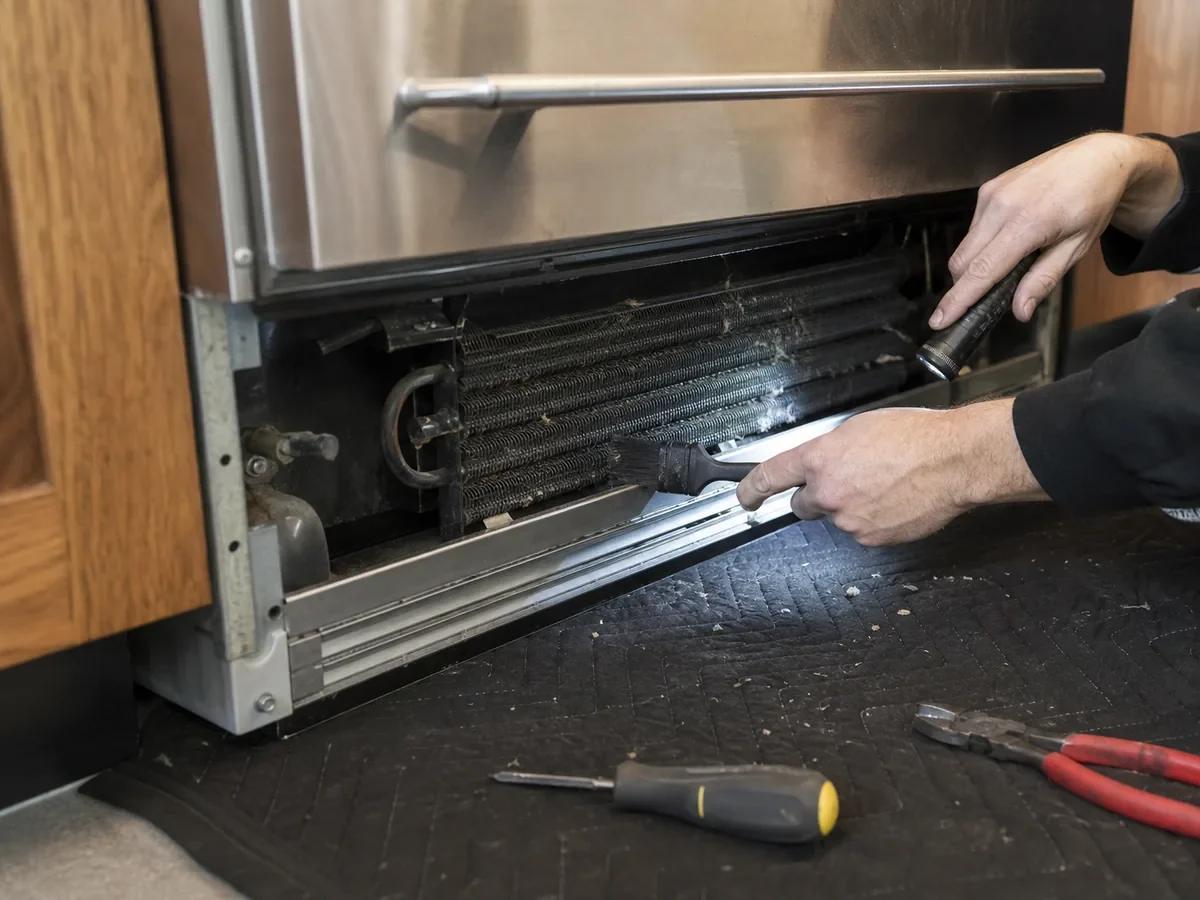
Technician hands servicing the lower access area of a built-in refrigerator with tools and floor protection visible.
Work processWork-process photo. The lower access panel is open with tools and floor protection visible; this illustrates how built-in refrigeration service starts without claiming a specific completed job.

Brand economics · 03

Why a Sub-Zero isn't scored like a mass-market fridge

"Repair always wins" is wrong, and so is "a fridge that age isn't worth fixing." Sub-Zero sits in its own bracket, and the honest answer respects both directions.

A standard $1,200 refrigerator follows a simple rule: once a major repair approaches half its price, you replace it. A Sub-Zero built-in breaks that rule in both directions. On the repair side, a Classic or BI column is engineered for twenty-plus years and is built around serviceable, individually replaceable systems — a failed evaporator fan, a hardened gasket or a control board is a routine fix on a unit that may have a decade of life left, and replacing the whole appliance would also mean reworking the cabinetry built around it. That combination is why repair genuinely wins more often here than it would on a free-standing fridge.

But the honest replacement cases are real, and we name them. When a sealed-system or compressor failure lands on a unit already past twenty years, the repair can reach the cost of a new column with little life-extension to show for it. When genuine parts are discontinued for an older model, a repair becomes a chain of salvage substitutes we won't stand behind. And when the cabinet itself is rusted or water-damaged, no amount of refrigeration work fixes the enclosure. In those cases we say replace — and we'd rather lose the repair than talk you into one that won't hold.

Three foothill cases · Local scenarios · 04

How the decision plays out across Los Altos Hills

These are illustrative scenarios, not specific completed jobs — written to show how the same matrix lands differently depending on the unit, the home and the cabinetry.

Scenario · Fremont Hills

Repair. A nine-year-old paneled BI column behind new millwork in a Fremont Hills remodel develops a warm fresh-food side. The freezer holds; the sealed system reads clean on gauges; the fault is an evaporator fan. Genuine part, drop-in repair, cabinetry untouched. Replacing here would mean refitting custom fronts for no gain — the score lands firmly on repair.

Scenario · Country Club

It depends — and only readings decide. A seventeen-year-old Classic near the Country Club stretch won't hold temperature on either side, compressor running constantly. This is the sealed-system case: on gauges it could be a recoverable leak repair or a failed compressor nearing replacement cost. We don't guess which — EPA Section 608 compliant readings settle it before any quote.

Scenario · Los Altos

Replace, honestly. A twenty-three-year-old unit in an adjacent Los Altos kitchen has a confirmed sealed-system leak, a control board no longer manufactured, and a cabinet base showing rust from years of condensation. Each factor alone might be survivable; together the matrix points to replacement, and we say so rather than chain salvage parts onto a failing enclosure.

Scenarios, not case studies

The three cases above are written to illustrate how the framework scores — they are not claims about specific customers or completed jobs. Your unit gets its own reading. The point is that the same symptom can land on either side of the line depending on age, parts and cabinetry, which is exactly why we score it on site instead of quoting blind.

Cost slots · Numbers · 05

What each path actually costs — as ranges, confirmed on site

These are honest ranges, not exact quotes. The exact figure for your unit is written up after the on-site diagnosis, with the $99 diagnostic credited toward any repair you approve.

Diagnostic visit

Flat $99, credited toward any approved repair — the reading that tells you which side of the line you're on.

Likely repair

Most fan, sensor, gasket, defrost and ice-system repairs land $300–$850, parts and labor in writing first.

Expensive exception

Sealed-system or compressor work runs $1,400–$2,900 — the repair most likely to make replacement competitive.

Replacement disruption

Beyond the appliance: panel refitting, possible cabinet modification and lead time — the hidden cost a repair usually avoids.

Local reality · 06

Why the Page Mill foothills tilt more calls toward repair than you'd expect

The single most common avoidable failure on this route isn't a worn-out appliance — it's a packed condenser. Foothill homes along the Page Mill foothills sit under oaks, and the pollen and fine dust that drift down load exposed condenser coils faster here than almost anywhere in the valley. An owner watching a Sub-Zero struggle to hold temperature can reasonably assume the unit is failing and start pricing a replacement. Often the real story is a coil so choked the compressor can't shed heat — a cleaning and a fan, not a new column. That's a repair-leaning verdict hiding inside a replacement-shaped worry, and it's why we read the condenser before anyone talks about replacing.

Access shapes the call too. Long private drives, gated entries and the older installs near landmarks like the Westwind Community Barn mean a service visit is a planned, scheduled event, not a quick swing-by — and replacement multiplies that disruption with delivery, panel refitting and a second crew. When repair keeps a working kitchen in service the same visit, the convenience math reinforces the technical math. We weigh both, because for these households a confirmed window and an undisturbed kitchen are part of the real cost of replacing.

What we check · 07

Before we ever say "replace," here's the evidence on the table

A replacement recommendation should rest on readings you can see — and the riskiest part of any built-in job is the cabinet pull itself.

The most under-discussed factor in a built-in decision is the cabinet removal and reseat risk. Pulling a panel-ready Sub-Zero forward to reach the sealed system, condenser or rear panel puts custom millwork in play — fronts can be scratched, alignment lost, water lines stressed. We treat that pull as part of the diagnosis, not an afterthought: we plan the route before touching the unit, protect the surrounding cabinetry, and reseat panel-ready fronts back to alignment. That same care is why replacement is rarely the "clean" option it sounds like — every reason a repair pull is delicate applies twice over when a whole appliance comes out and a new one goes in.

And we put the evidence in front of you before any verdict. Temperature readings in both compartments, condenser and evaporator photos showing frost pattern and coil load, model-tag proof read in person to confirm what parts your serial actually takes, and the OEM fan, gasket, control-board or valve packaging when a repair is the call. On a sealed-system suspicion, the EPA Section 608 compliant gauge readings by a qualified technician join that record. If those readings say replace, you'll see why; if they say repair, you'll see that too — the decision is something you can read, not an adjective.

Pricing

Sub-Zero repair vs replace in Los Altos Hills

Sub-Zero repair vs replace in Los Altos Hills (planning ranges)
PathTypical scopeCost rangeWhen it makes sense
Targeted repair (non-sealed)Evaporator fan, gasket, thermistor, ice maker or control board$300–$850Sound sealed system, unit under ~15 yrs, single fault
Sealed-system repairRefrigerant leak repair or compressor replacement$1,400–$2,900Cabinet and cabinetry sound; value or wine storage justifies it
Replace built-in + cabinetryNew built-in, panel refit and millwork adjustment$9,000–$18,000+Multiple major failures or an unsafe sealed system
What determines the final price

What tips the score: the sealed system’s health, the cost of the specific part, and how much custom cabinetry a swap would disturb — confirmed on site after the $99 diagnostic.

After the diagnosis, not before

Check whether repair makes sense before replacing

Have your Sub-Zero model number and symptom line ready when you call or book online. We'll tell you which factors point where, the honest range for each path, and whether this is a clear repair, a clear replacement, or a sealed-system call that needs gauges on site before anyone quotes.

Mon-Sat, 7:00am - 7:00pmAppointments are requested by phone or external online booking only.

Questions · 08

Repair-vs-replace questions we get in Los Altos Hills

At what age does a Sub-Zero stop being worth repairing?

There's no single cutoff — Classic and BI built-ins are engineered for 20-plus years, so age alone rarely decides it. What decides it is age combined with the other factors: whether the sealed system is intact, whether genuine parts are still made for your serial, and whether the cabinet is sound. A sixteen-year-old unit with a single fan failure is a clear repair; the same age with a failed sealed system and discontinued parts is not. We score the combination, not the number.

Is a sealed-system repair ever worth it, or should I just replace?

Sometimes yes. A confirmed refrigerant leak that's accessible and repairable, on a unit otherwise in good shape with sound cabinetry, can be worth the $1,400–$2,900 range against the full cost of a new column plus cabinetry refitting. What makes it not worth it is a failed compressor on a 20-plus-year unit, or a leak we can't reliably locate. We only know which after EPA Section 608 compliant gauge readings by a qualified technician — that's the one decision we never make from the kitchen.

Does replacing my Sub-Zero mean redoing the cabinetry?

Often it means refitting it, at minimum. Panel-ready and integrated columns are sized and trimmed into custom millwork, so a new unit usually needs the panels refitted and sometimes the opening modified — rarely a clean drop-in. That hidden cabinetry cost is a real part of the replacement total, and it's exactly why a sound repair that leaves the millwork untouched often wins the math even when the repair itself isn't cheap.

Can you tell me repair-or-replace over the phone?

We can tell you which way the factors likely point from your model, age and symptom — but not a final verdict on anything touching the sealed system. Both compartments warm or a constantly running compressor needs gauges on the unit under EPA Section 608 before we'd commit to repair or replacement. For everything else, the $99 diagnostic gives you readings and a written direction, credited toward any repair you approve.

Does replacing a built-in Sub-Zero in Los Altos Hills mean redoing the cabinetry?

Usually to some degree. Panel-ready built-ins are fitted to custom millwork, so a new unit often needs panel refitting or cabinet adjustment, pushing replacement to $9,000–$18,000+. That cabinetry cost is why a $300–$850 repair, or even a $1,400–$2,900 sealed-system fix, frequently wins on a sound cabinet.

At what age is a Sub-Zero no longer worth repairing here?

There is no fixed age — Classic built-ins are built for 20-plus years. We score it on the sealed system’s health, the cost of the specific repair, and cabinetry impact. A 15-year unit needing only a $520 fan is worth it; one needing a compressor plus other major parts on a tired cabinet may not be.

Keep reading

Where to go next

Local review signal

Google review highlights for Sub-Zero repair-versus-replace assessment in Los Altos Hills

Owners usually care about the same three things: careful diagnosis, protected cabinetry and a quote that follows evidence.

4.9/ 5 from 214 Google reviews
★★★★★

They scored our 16-year-old BI-42 honestly — a sound sealed system, just a fan and gasket for $520 versus about $12,000 to replace with cabinetry rework. An easy decision.

Homeowner, Country Club
★★★★★

When our Designer column had a failed compressor, they laid out $2,400 to repair against a roughly $14,000 integrated replacement. We repaired and saved the millwork.

Estate owner, Altamont
★★★★★

Our 15-year-old UC undercounter wasn't worth saving — they said so plainly rather than selling a $1,900 sealed-system fix on a $3,000 unit. The honesty earned the kitchen job.

Homeowner, Fremont Hills
Call (650) 668-1043Book